poetry

Bruegel’s Icarus: We Really Don’t Care. Do We?

La chute d’lcare Pieter I BRUEGEL (BRUEGHEL)

Ca. 1527/30 - Bruxelles 1569

Musées royaux des Beaux-Arts de Belgique, Bruxelles / photo : J. Geleyns - Art Photography

After all these years. Finally, here I am. Face to face with you. In the flesh. You, fine example of Flemish Renaissance. You, precursor to the Baroque. You, you perplexing driver of thoughts. You’ve been an inspirational thorn in the side of many.

In the Royal Old Masters Museum in Brussels, like W. H. Auden and many others before me, I stand in front of the work, Pieter I. Bruegel’s Landscape with the Fall of Icarus, the painting I have taught throughout my career as an English professor in mythology and literature classes but have only seen in slides. I’m with my sister on vacation in Belgium. Because she has nerve damage in her feet, it’s hard for her to tour museums, so I push her through the building in a wheelchair, which ensures I have a captive audience at this moment. I set her up in front of the painting, explaining the significance of this meeting for me.

What follows is some of what I told my sister—augmented with much of what I have taught and thought for many years. You might wonder if seeing the actual painting changed my appreciation for it in any way, and I would have to say, probably not. But I don’t mean to suggest an anticlimactic experience. It was more akin to the ideal culmination of a pen pal relationship: the other of your correspondence turning out to be exactly what you imagined and hoped for. No finding out you were catfished. No crushing disappointment. No feeling of, “meh,” as so many people report with the Mona Lisa in the Louvre. Then again, I wasn’t fighting a bus-load of tourists with cameras flashing, standing 50 yards away. I was up close and personal, capitalizing on an intimate relationship that took a good portion of my life to cultivate.

I tell my sister what I’ve told my students. The best way to begin is to play treasure hunt. Where’s Icarus? The painting features a well-dressed burgher in the foreground, plowing a field in tandem with an equine, head bowed as he tills the soil. He’s the main event in the composition, enlarged and bedecked in complementing red and green to showcase his resplendent costume. In the background, a landscape of sea and sky, sun and ships opens to a wideness that dwarfs the human players. If you are persistent, though, you will find, towards the right corner off the shoreline, a pair of small kicking legs indicating an inverted figure breaking the water surface. This is the fallen Icarus—faceless, drowning—insignificant, it seems, in an event in which you imagine him center stage.

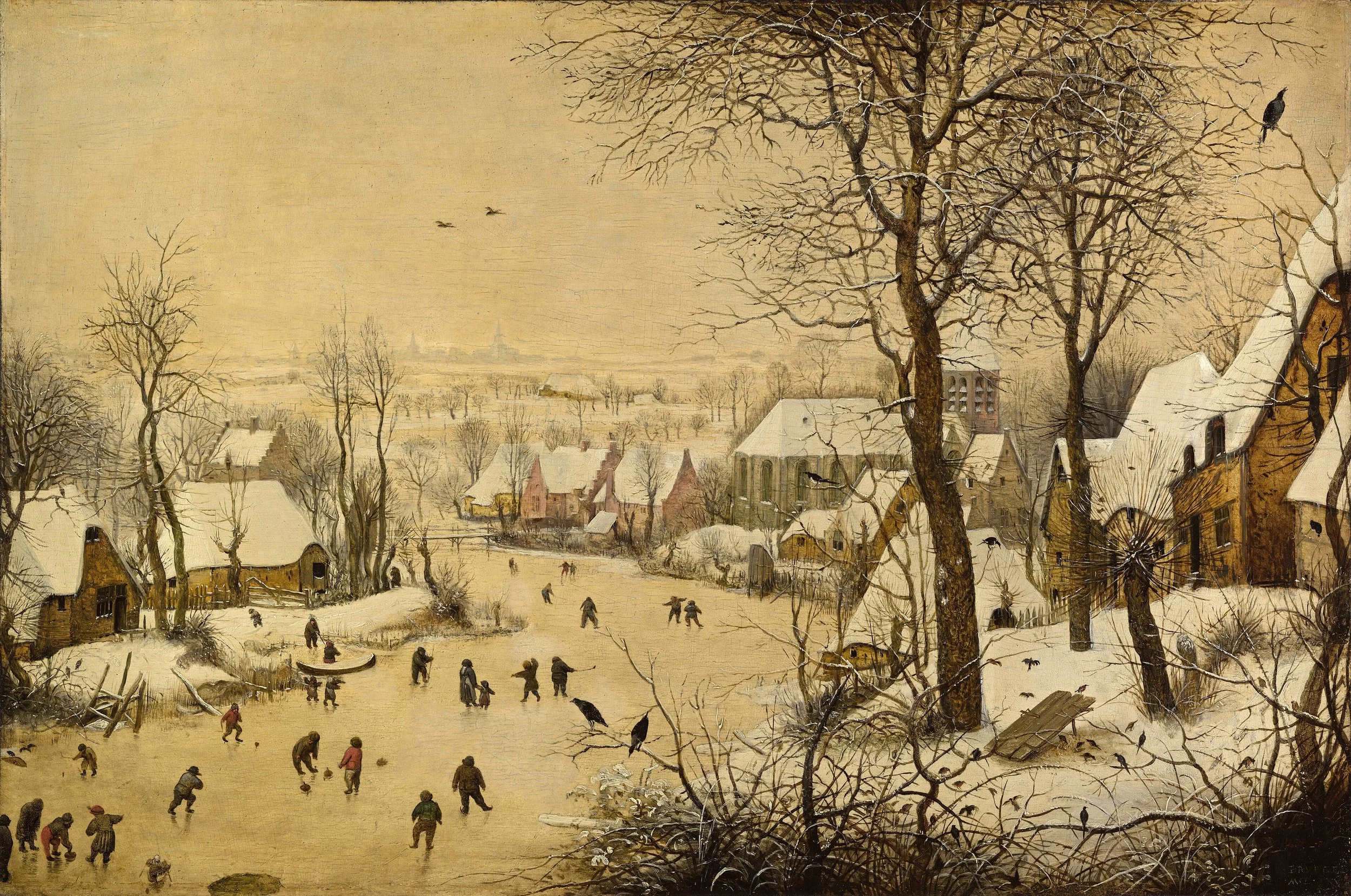
Your first reaction to your discovery might be to laugh. Expecting the tragedy we associate with Ovid’s story of the boy who flew too high and fell too far, the viewer instead is treated to the comic absurd, that is, Bruegel’s absurd, which, like Hieronymus Bosch’s, is a bit sinister. A good illustration of what I mean is found in another Bruegel painting, The Bird Trap, a delightful snow scene of skaters that includes, off to the side, the device of its title. The idyllic narrative of the everyday is disrupted by the implied impending capture: the crushing of the songbirds that have gathered to feed at the baited trap. The necessary violence that underwrites the quotidian joys of existence is unremarked, but it is there, subtly infused through every strand of the commonplace. The enabling constraint of static depiction inherent in the genres of painting allows Bruegel to achieve the effect. We are stuck in the narrative frame before the trap is sprung, thus rendering the violence implied rather than accomplished, evoking sensations in us of the uncanny rather than simple horror.

The same can be said of the Icarus painting, only in this case, my attention diverts to the action preceding the static moment of Icarus’s fall. What were the other denizens of the scene doing prior to the great failure? In Ovid’s poem from the Metamorphoses, the most widely known source for the story, he focuses on that action, describing the shock and amazement at seeing a young boy in flight. But Bruegel’s ironic referencing and warping of Ovid takes us to a darker place. His characters respond in exactly the opposite way from the poet’s. Rather than watching aghast the tragic flight unfold, Bruegel’s ploughman, shepherds, and sea-faring vessels either never even see the young boy or, having seen, turn away to carry on with their lives, uninterested, unimpressed, or seemingly unable to intervene. We cannot know which, but the differences are arguably crucial in how we view our own agentive capacities as well as our fellow humans with whom we share this earth.

In his ekphrasis “Musée des Beaux Arts” (1938), Auden presumes to answer the question for us, or we think he does. The poem’s speaker, taking in the plenitude of the museum’s collection, announces “About suffering they were never wrong,/ The Old Masters: how well they understood/ Its human position,” and then directs our attention to the specific example in “Breughel’s Icarus” that the speaker is pondering:

. . . everything turns away

Quite leisurely from the disaster; the ploughman may

Have heard the splash, the forsaken cry,

But for him it was not an important failure; the sun shone

As it had to on the white legs disappearing into the green

Water; and the expensive delicate ship that must have seen

Something amazing, a boy falling out of the sky,

Had somewhere to get to and sailed calmly on.

While Auden hedges on the ploughman, he is convinced that the sailors must have seen Icarus yet continued on their way, commerce’s exigency taking precedence over a singular human life. Given the year of publication, readers sometimes conclude that Auden is commenting on a populace’s apathy in the face of rising fascism, concerned with their own lives and not the in-progress atrocities and loss of our collective humanity. This interpretation, while plausible, is heavy-handed and moves us away from the subtle frissons of Bruegel’s narrative. To be fair, such a view of “Musée des Beaux Arts” disallows an ambiguity that Auden’s words themselves preserve. Rather than deliberately turn away, the ploughman may not have seen Icarus at all. In other words, he may have missed the entire air-borne spectacle.

Why?

The poet Michael Hamburger offers a reason in his more recent “Lines on Brueghel’s Icarus” (1984): “The ploughman,” he tells us, simply “ploughs.” The speaker describes a routine existence that does not permit viewing what in Auden’s poem is “something amazing.” Hamburger goes on to describe sailors and shepherds, even sheep, whose lives are so narrow and exclusionary as to disallow the ability to see or comprehend feats of the ancient champion defying “the ordering planet.” This, then, is less about apathy and more about stunted growth and limited possibilities. The ploughman has been so spiritually and emotionally impoverished by his chronic furrow-making that he is incapable of looking up and appreciating the wondrous—or someone engaging in the impractical, which indeed is what occurs when Icarus turns his flight into an epic achievement rather than a means of desperate escape. The ploughman’s sensibilities are literally in a rut, and his plough is for him what our phones are for us today: the device that keeps us from noticing what is happening around us.

Unlike Auden who focuses on human suffering, Hamburger is interested in portraying the heroic difference between Icarus and others. But in doing so, he also curtails the possibilities presented by Bruegel. There is more than a touch of condescension in Hamburger’s treatment of the scene’s laborers, which is arguably not part of Bruegel’s vision. Instead of a hopeless world bereft of compassion or empathy, Bruegel’s focus on the ploughman could just as easily suggest a reverence for life and survival. Was Icarus’s act of defiance heroic or merely self-indulgent, and if the latter, can we then view the ploughman as a sustainer of life whose homely work brings forth food from the earth to nourish the human race? Unlike the obtuse refuseniks in the contemporary movie Don’t Look Up, who belligerently disregard the evidence of their own senses, our ploughman and his earth-bound gaze may embody a kind of authentic persistence in a world filled with sensational distractions. After all, we might ask about the nature of Icarus’s so-called achievement; whether he is a mover of boundaries or merely a thrill- seeker. Not that the two must be mutually exclusive.

When Melania Trump visited a migrant children’s detention center in Texas wearing a jacket with the now infamous phrase “I don’t really care. Do U?”, many of us were appalled by the tone-deaf choice. It was difficult not to experience this symbolism as insensitivity to suffering children separated from their desperate parents, despite assurances from the First Lady to the contrary. But I have wondered whether, in another context and projected from a different ethos than FLOTUS inhabits, the phrase on the jacket might have hit different. Instead of callousness, the refusal to care about the judgments of others can be a productive defiance, as much as it might be a childish rationalization to evade standards of decency. On the other hand, refusing the rapture of the sensational is another kind of rebellion. The ploughman’s conformity is not mindless but good judgment, something the dare-devil Icarus failed to display. The ploughman has stuck to his task and won the day. He endures with his feet on the ground. There’s no need to buy into the dualistic conceit that lofty aspirations are any more worthwhile than what terra firma has to offer.

But Bruegel’s ploughman as a contemporary well-to-do citizen, placed anachronistically in a mythic structure, may not align with such a wholesome view. His fancy dress, distancing him from the peasantry, makes him less the salt of the earth and more a prosperous farmer taking advantage of the profits to be made from agriculture under capitalism. The economy is thriving, and so is he. In the modern world, there is no longer need or room for the ancient hero and his tales. We truly don’t care about Icarus. Icarus never had the chance to grow up, but we have. Nostalgia, who needs it?

Well, maybe poets like Hamburger. Hamburger lauds Icarus as an “angel” in contrast with the “churlish” folk who people the world, a dime a dozen. James Joyce, along with the poet Anne Sexton, saw Icarus as the artist who flies higher and sees more than the rest of us left below on the ground, purblind and numb. The romantic view, if elitist, even narcissistic, is hard to resist—unless, like Bruegel, you find a bit of pleasure in the perverse. Of course, we might see the glorification of a doomed venture as its own worthwhile perversity. So it is with Sexton’s “To a Friend Whose Work Has Come to Triumph,” a sonnet inspired by the Icarus legend (as well as Yeats’ “To a Friend Whose Work Has Come to Nothing”) but not, as far as I know, by the Bruegel work. For Sexton, failure is not an option for Icarus because there is no failure, only a steep price to be paid for the great privilege of achievement. Delightfully, Sexton takes us full circle when her poem asks of Icarus: “Who cares that he fell back to sea?” This is not the same question of care that an absorbed ploughman poses for us or a clueless First Lady.

Instead, it is a defiant declaration of “triumph.” We might imagine George Clooney’s character, Jay Kelly, someone who sacrificed personal ties for fame, taking solace in Sexton’s couplet: “See [Icarus] acclaiming the sun and come plunging down/ while his sensible daddy goes straight into town.”

Sexton invites us into full-on tragic mode, complete with fall, the pleasure of which Bruegel potentially seeks to rob from us. Milan Kundera says that tragedy saves us because it provides us with the illusion that we matter; we are important enough for our failures to count. From The Art of the Novel (1986): “By providing us with the lovely illusion of human greatness, the tragic brings us consolation. The comic is crueler: it brutally reveals the meaninglessness of everything.” As a Czech writer who lived in exile during the Cold War, Kundera was preoccupied with the hair’s breadth that often separates tragedy and the comic absurd and how one easily transforms into the other. In the second quarter of the 21 st century, we know about this all too well; we hover in the nowhere of disbelief, between laughter and tears. We watch comedians mine the unrelenting news cycle by parodying events that are already parodies of themselves. We witness those who dictate our destinies, wearing large hats and clown suits while they crash the clown car which, it turns out, contains our lives.

Bruegel also knew this territory of bitter irony that, if we were inclined to bottom-line it, might be summed up in the expression, “funny/not funny.” After we laugh at those silly flailing legs of our fallen Icarus, we realize the joke is on us. We are left with the messy work of sorting out what is lost and what remains and what, after all, we are to do about it.


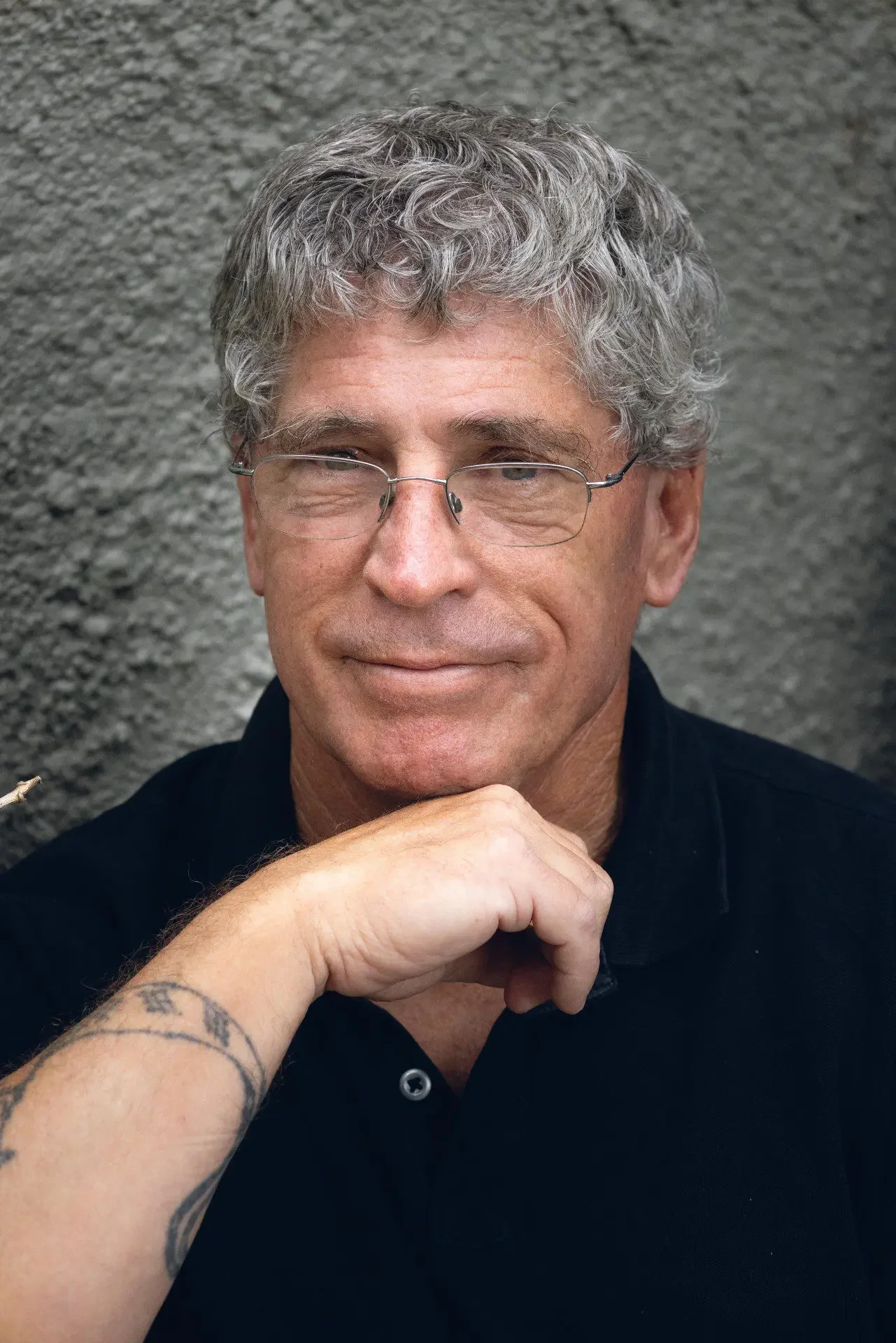
Wendy Ryden

is a retired Professor of English, Long Island University, Post campus.


G&E In Motion does not necessarily agree with the opinions of our guest bloggers. That would be boring and counterproductive. We have simply found the author’s thoughts to be interesting, intelligent, unique, insightful, and/or important. We may not agree on the words but we surely agree on their right to express them and proudly present this platform as a means to do so.

The Psychedelic Poet

I’ll start with caution by saying that it’s still a surprise to me that I have been doing poetry for the last several years and that I have been recognized as a poet. It’s a surprise because I have been a comedian since 16 and five years ago, I went onto a spiritual path that has led me to explore my own healing through ceremonial plant medicine/psychedelics and mindfulness. So now at 33 I have surrendered into my own gifts with regards to the work of holding space.

I can’t tell you about the different genres of poetry or give you a list of the most influential poets in history. I can’t write a poem based on a theme that you give me, or better yet I refuse. My grammar is seemingly nonexistent, my spelling still haunts me, and I never liked English class. Now here’s a few things that I do know…I know timing from doing comedy. I know how things should sound from my love of music. I know what I have seen in my own experiences with psychedelics, love and my relationship with the spirit realm. I know there is some invisible thread from the shamans, mystics, medicine men and women to the song writers, story tellers and poets.

I feel this lineage in a cosmic sense deep beneath my skin. And lastly, I always know where my heart is coming from. This is what gives me the confidence to step on stage along accomplished published poets and academics. I am not going up there to read a poem. I’m going up there to pray.

About two or three years ago when I was at a plant retreat while going through heart break I remember being around the fire with some of the guys and someone asked, “Does anyone know any poems?” My eyes went from staring into an abyss to him as if he just threw me a line to get back. I recited two poems of mine and then the third was Charles Bukowski’s “The Laughing Heart.” I’ll never forget one of my brothers in this community said, “Mike, when you spoke it was like the moon went out.”

As time went on and I kept going to the retreats, I started to then get asked if I could do a poem or two…this would always be spontaneous as the night went on and we were all very much feeling the plant medicine. In the beginning I remember how surprised and curious I was when I’d get asked. I was hyper-aware that I didn’t want to make it seem like I was taking over the space or getting too performative. This is a space I respect dearly; it is holy ground to me. But whether the community knew it or not they helped me get over this. Because every time people asked me, it was as if they gave me an invitation to step more into myself, my power, my own visibility and my own voice. I’ve read that in history, depending on the culture, shamans didn’t bestow that title upon themselves. Instead, they received that title only if their community saw them as such. I feel like my community at those retreats had given me the title of poet (and wizard being another one). Also, I think what surprised me the most was how it made total sense for me to be doing this; it’s a combination of two of my favorite things. Its sharing my words and holding space for people during their experiences. This was a beautiful handshake between the two.

In those moments it felt like the planets aligned.

I think one of the main reasons I was asked if I could write about this is to talk about what it’s like for me when I’m doing poetry for people in such spaces while I too am experiencing the medicine. And since I have been doing this a lot, I’ll try my best to share what it’s like only on my end.

I’ll be somewhere in the space, be it laying down or walking around checking in on people, and someone might bring up that I’m a poet. If it’s a moment where they don’t bring it up, but I feel something energetically calling me to share then I would ask if they would like me to do one for them that feels right based on how they tell me they are doing. I make sure to say it’s just an invitation, so that they can always say no or if they’re not feeling it’s the right time.

But if they do ask then this is what seems to happen. I usually find myself kneeling. I allow a bit of silence (that silence is where my words swim). I gather my mind trusting I will remember the words, and then I take a breath. It’s as if that breath is taking us into this poem, this small pocket of time, this realm, together. There’s no reading and I don’t feel like I’m reciting it…I’m simply allowing it. This may even look like I’m just having a conversation until you notice the words are rhyming. I’ll try to compliment whatever music is playing in the space. I do my best to lock into a pace that feels right for whoever I’m doing this with (not doing this “for” but doing this “with”). I know that like myself, their senses are very much heightened, so I become very aware of the rhythm, when to pause, and how my inflection is while letting my hands feel this energy. I don’t pretend to have any knowledge of what those hearing this are feeling. I can only control my intention. Letting each word out with love and a positive vibration behind it. I can even find myself getting a bit emotional because I am always reliving whatever inspired the poem in the first place.

Depending on the piece I often feel like each line is shedding more of me away…from my skin and my muscles to my bones to my soul and then releasing my spirit into the air. I always see those who I’m doing this with (be it at retreats, poetry mics, senior centers or a one-on-one) close their eyes and have this pleasant restful smile, slowly nodding it’s as if they “know.” It is a knowing that is magical and mysterious. Simply recalling these memories from my point of view, as I’m typing this, is making me tear up. It is an absolute honor for me to do this for people in those moments, and I am so grateful to have been called time and time again to share my words, my offerings. This is my service for my time here in the universe.

So, who am I now? What am I becoming? Comedian? Poet? Healer? Wizard? What the heck is all this?

I think a lot about George Carlin’s 1996 conversation with Charlie Rose. “Arthur Koestler said in The Act of Creation said that sometimes the jester can traverse the triptych. And if the jester says something funny, well, he’s a jester. If he says it in marvelous language that we say ‘oh isn’t that a nice way to put that’ then he’s a bit of a poet. And if there’s an underlying idea underneath the well-put funny line, if there’s a bit of a philosophy there, he comes something else again: a philosopher. Now one doesn’t sit and attempt do that with everything he writes but to know that that’s part of the package, to know that you can do these three things in varying degrees.”

With all that said, I look forward to continuing to honor this path that has found me. And to do my best to allow myself to grow further into this.


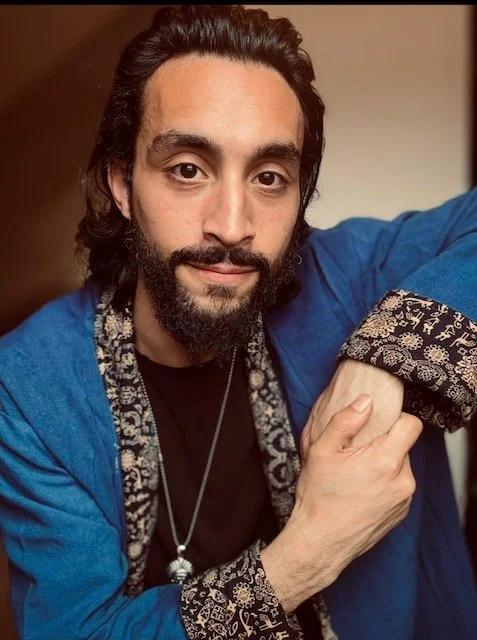
Michael Pagano

is a poet, mystic, and comedian who has been studying the magic of retreats for healing. His goal is to share his words on stage for larger audiences as well as leading his own retreats.

You can find him on TikTok and YouTube


G&E In Motion does not necessarily agree with the opinions of our guest bloggers. That would be boring and counterproductive. We have simply found the author’s thoughts to be interesting, intelligent, unique, insightful, and/or important. We may not agree on the words but we surely agree on their right to express them and proudly present this platform as a means to do so.

Splitting the World Open

Poet. Feminist. Activist.

These are the three words I chose to identify myself on my “business” card. I realize the “f” word, not to mention the “a” word, is polarizing and might turn some people off, but then those people are not likely to enjoy my poetry. In fact, I was recently told that my poetry and the National Organization for Women (NOW) where I was a board member were too “aggressive” for a self-described women’s empowerment group that invited me to read at their event. They didn’t think my poem about Cinderella ditching the glass slippers and becoming a feminist was empowering or humorous. Honestly, I thought it was one of the least “offensive” poems I could have recited:

After

the wedding they never dance again

. . .

She sells the slippers on e-bay, goes back to school

for a degree in Women’s Studies,

and writes a second book on feminist philosophy:

How to Survive Happily Ever After.

Readers often assume I’ve worked in women’s services or have a Women’s Studies Degree. Neither is true, though I do think that some university should award me an honorary degree. As the oldest daughter of a teenage (sometimes single) mother, I had a front row seat to the difficulty of trying to survive as a woman under the patriarchy. I wish I could say my mother modeled how to resist and break free. Instead, I learned what not to do if I wanted to break the cycle and become an independent woman.

Some of my earliest memories are of crying “That’s not fair,” and my mother asking in response “Who told you life was fair?”

I always had an innate awareness of all the ways the world was unjust; particularly to women.

In college, I took a course on Women and the Law at Stony Brook University. This is my origin story: it confirmed and made explicit what I had always intuitively known about the patriarchal structure of society and institutional gender-based oppression. I acquired the framework and language with which to more articulately express the many injustices imposed on everyone who isn’t a hetero, cisgendered, white man.

At poetry readings, I’m sometimes asked how I know so much about social injustice, gender discrimination, and violence against women. I give the traditional answer about the vocation of the poet (with a twist). Writers are always advised to pay attention. We usually interpret this to mean pay attention to trees and birdsong, but I pay attention to society. I write from my life, the lives of women I know, the lives of women I’ve read about, the world I exist in.

I practice empathy and use my imagination to write the truth.

Poetry has space for all kinds of poets: nature poets, lyric poets, narrative poets, and activist poets. All those subjects and voices are valid and worthy. They all seek to preserve some truth, and, even when the truth is ugly, poets can use beautiful language to convey that truth. John Keats’s lines are still relevant today: “Beauty is truth, truth beauty,—” Robert Frost paid attention to rural life in New England. Ada Limón pays attention to horses and her Latinx heritage. I pay attention to social injustice and write poems about it.

Does writing about social justice make a difference? Poet Steven Clifford has asked me (and others) “Can poetry change the world?” I’m still looking for an honest and meaningful way to answer that question. What can my Cinderella poem do today (besides make a group of women at high tea uncomfortable)? Can it feed the hungry? Ensure equal pay and access to healthcare? End discrimination, genocide, and war? Can you get the news from it? Not according to William Carlos Williams who wrote: “It is difficult to get the news from poems . . .” So what can we do? We can bear witness. Salman Rushdie (who knows first-hand the power and danger of wielding language) writes: “We can sing the truth and name the liars.”

Because abusers rely on the silence of their victims, speaking out is a profound act that lets women know they aren’t alone, encourages empathy, and builds community.

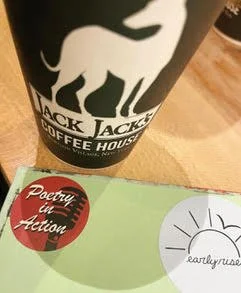
Sometimes that community is tangible. I create space and gather poets at the open mic that I host for the Babylon Village Arts Council at Jack Jack’s Coffee House in Babylon, NY (join us on the first Thursday of every month). Sometimes that community is virtual. After Roe v. Wade was overturned, NOW’s Suffolk, NY chapter responded by organizing a virtual poetry reading in support of women’s reproductive rights. I invited over a dozen poets to read. Some of them I knew personally. Many I had never met other than between the pages of an anthology we were published in (Choice Words: Writers on Abortion, Haymarket Books). Almost every one of them participated in the reading.

W. H. Auden wrote “For poetry makes nothing happen.” I disagree. My bio reads: “Her work explores the intersection of poetry and activism.” Initially, that referred to the subjects I wrote about. However, during my term as Poet Laureate of Suffolk County, NY (June 2023-2025), I moved activism off the page and into the streets (well, more accurately, into a coffee shop, a bookstore, and a farm) with events called Poetry in Action. With the help of the community and poets Rosa Todaro, Lisa James, and Steven Clifford, I organized two fundraisers for local charities, a volunteer event at a local non-profit farm, and a get out the vote postcard writing night. Poetry made something happen at these events: it brought people together to celebrate poetry and serve the community.

Sometimes the impact is less visible. I have many poems about breast cancer and have learned it is a radical act to write openly and honestly about cancer (particularly cancer of the breast; an external gender marker). But every time I read those poems, at least one woman in the audience connects with me to ask how I am, or to thank me for writing about cancer, or to share her own experience with illness. Recently a young woman said she had a lump in her breast and had been wondering if it was okay to write about it. I assured her that it was and encouraged her to do so. Maybe my reading made that one woman feel less alone and more empowered. Does that change the world? I’ll never know, but it’s meaningful to the two of us, and who knows how that small exchange may reverberate across the universe. (Update: as I was drafting this, that woman wrote and published the essay she was unsure about writing).

Silence is a tool of the patriarchy. Silence about discrimination, abuse, assault, or illness isolates and shames us. Poet Muriel Rukeyser wrote in her poem titled “Käthe Kollwitz”: “What would happen if one woman told the truth about her life? / The world would split open.” Let’s all continue to speak the truth. Let’s all stay aware. Pay attention. Bear witness. Write. Read poetry out loud in public spaces. Let’s keep telling the truth and trying to split this world open.


Deborah Hauser

is the author of Ennui: From the Diagnostic and Statistical Field Guide of Feminine Disorders (Finishing Line Press). Her poems and book reviews have appeared in Ms. Magazine, Women’s Review of Books, The Kenyon Review, Prairie Schooner, Bellevue Literary Review, Calyx, and Academy of American Poets Poem-A-Day, and elsewhere. Her work explores the intersection of poetry and activism.

She has taught literature and writing at Stony Brook University and Suffolk County Community College. She curates and hosts a monthly poetry reading series at Jack’s Coffee House for the Babylon Village Arts Council, has served as Secretary and Board Member of the Suffolk County Chapter of the National Organization for Women (NOW), and is on the board of the Long Island Poetry & Literature Repository. She leads a double life on Long Island where she works in the insurance industry and served as Poet Laureate of Suffolk County, NY (2023-2025).


G&E In Motion does not necessarily agree with the opinions of our guest bloggers. That would be boring and counterproductive. We have simply found the author’s thoughts to be interesting, intelligent, unique, insightful, and/or important. We may not agree on the words but we surely agree on their right to express them and proudly present this platform as a means to do so.
TALES AND TRAVAILS FROM A NOT-YET-DEAD POET

Stories- we’re fascinated by them…stories of people, places, indelible traces…

…What was that song -you know the one I mean-

from “back in the day” - that song which still

occasionally drifts into YOUR head even today- like

the smiling ghost of an old friend- and you still

remember those lyrics all these years later - and you

feel that nostalgic twinge - of those ol’

“warm’n’fuzzies”…?

What was your song??

Chances are, those lyrics - of “your song” - were

performed - in Poetic Form!

In a nutshell THAT’S the Power of Poetry - what’s

said - and HOW- it’s read…can create an impression

in your mind.

Like most, I didn’t start out on my journey by

dreaming of becoming a Performance Poet…

Hardly.

And if you’re like me, your “education” about the

spoken word likely began early…

My Mom could affectionately whisper my name “Jim”

in such a sweet way that I’d feel like the best-behaved

Little Boy on the planet…

Or…she could ear-splittingly screech “JIM” on those

rare occasions, almost curling the paint on the walls,

when my Devilish nature took over- and I “allegedly”

misbehaved…!

Inflection 101.

In school, do you remember- as I do - that teacher

who made the lesson “come alive”- and pique your

interest in an otherwise hopelessly dull subject?

…And - that “other” instructor, whose low monotone

would almost make you prefer the nerve-jangling

sounds of fingernails -excruciatingly clawing their way

down -that scarred, tortured blackboard?

Inflection 201.

I’d learn more about inflection- and the necessity of

speaking & writing concisely- precisely - in my short

stint as a Newspaper Reporter in the now-defunct

Hartford Times in the mid-70’s…

A year out of College, there I’d be, agonizingly taking

notes during 4-hour local Planning & Zoning

Commission meetings - listening to some dreary

Politico take 10 minutes to drone on about his

mundane musings - which he easily could’ve wrapped

up in 2…

At that point, I knew…if I ever got my hands on a

microphone - I vowed “Don’t Be That Guy”…

To this day, I keep reminding myself…”You still love

groovin’ to the Allman Bros “Ramblin’ Man” - but

unless you can play guitar like Dicky Betts- (and I

can’t) don’t be one yourself”!

Be Clear & Concise - 101.

Back then I also began working in my first love-

Radio- at WCCC-FM - a Rock station - where I

rubbed elbows with a rising young talent- 24-year-old

Howard Stern.

During his year-plus in Hartford, Howard was evolving

- turbocharging his career - almost from the Clark-

Kent-like mediocrity when he first began - to

Superman status toward the end of his meteoric reign

in Hartford. Shortly before he moved up to the top-tier

markets, I saw him onstage at a huge concert venue -

where most of us exposure-craving DJ’s would

eagerly jump at the chance to stand in front of the

throngs of fans- and bring on the headliner…

But with the spotlight momentarily on him- Howard

didn’t do what most other jocks did- excitedly

announce the list of other shows “coming soon” to the

City…instead - he only bellowed out these three

words…

“I’M HOWARD STERN”

…and the fans in that sold-out Civic Center unleashed

a deafening roar…

Stage-presence - Postgraduate Level.

During my radio years, I sold advertising full time, and

pulled part-time air shifts too…

Had plenty of fun spinning the tunes- but carrying on

a conversation by yourself on mic is an acquired, yet

elusive art… and since I couldn’t captivate an

audience like Howard Stern could, the Bombastic

Boss kept exhorting me to - in so many encouraging

words - “Shut up and play the hits!!”

In selling to clients, on the other hand, I drew upon my

experience as a reporter…each had their own story-

and the more questions I could ask them - the better

I’d do - and success would usually follow.

Early in my career, I’d write the ad copy for some of

the smaller businesses myself - as creatively as I

could within the 30 or 60 second commercial “walls”-

while still working on the essentials like the name,

location, products - all that fun stuff!

And for that matter, writing Newspaper stories was

another exercise in brevity- for news coverage, you

get to the meat of the matter- and write at an easily-

understood Grammar School level. When the story is

complex- boil it down!!

I much preferred feature writing, where I could

interview, then flesh out their story with personal

anecdotes …but those opportunities were relatively

few.

During election season, we’d read the press releases

sent in by the local candidates for office - hoping we’d

publish…

Now, I always looked at writing as a “life skill”- almost

like breathing…and since I could functionally breathe

and write- I assumed nearly everyone else could,

too…

Then, I started reading a few of the mangled “Press

Releases” sent into the second-largest Newspaper in

Connecticut on behalf of these local candidates…

Silently shaking my head, I’d mumble…”OK- so- not

“EVERYONE” - can write!!”

Be Clear & Concise. 201

Many years later, I moved on to selling billboard

advertising for a large corporation- Lamar Adv. Co.

Occasionally, we’d get email communiques from

Corporate HQ in Baton Rouge- directly from the CEO

- and his messages were astonishingly simple…

Rather than show off his Mighty Corporate Stature or

his Elite Harvard University Education, he was laser-

focused on delivering an easy-to-understand

Directive- leaving no room for ambiguity or

misinterpretation. He’d make HIS words- count!

Less…IS More…

Be Clear & Concise. Post-Graduate Level

After retiring, I eventually dusted off my pen and

joined a local Writer’s Group and we Zoomed

through the Pandemic. Now sometimes, ANY Zoom

Meeting can be like Root Canal without the Novocain,

so I tried to spare The Group that agony - with fast-

paced story-writing, provocatively igniting, tried to be

engaging -occasionally enraging - and as entertaining

as possible…and since I DON’T play the Guitar…no

rambling!

Occasionally, I’d write in verse…then one day, I heard

about this group- The Shore Poets- with live Open

Mic sessions in the Long Beach NY Library…

And suddenly…all these “lessons” I’d been learning-

all came together!!

My poetic stories can be brief & whimsical…30

seconds for

“Catfish me- my real-life fantasy”…”she doesn’t care

about our 50-year age gap- swore to me so as she

slid down her strap”…

A different story- can be a wee bit longer - like my

dubious “Poets Guide to filing your Taxes”…laced

with a few improbable scenarios!

Yet another takes you through the real-life story of the

Incan “Ice Maiden” - a young teenager sacrificed to

the gods 500 years ago- pondering all the family and

village dynamics which led to her bearing the curse of

becoming “the chosen one”…to save everyone she

knew…

But it doesn’t end there- for her remains were

famously discovered in 1995, studied, and she would

subsequently “teach us volumes, without uttering a

word- your mitochondrial DNA was so well-

preserved”…

And - if given the fateful choice- would she have

chosen…

…”To reappear in 500 years- like a Sleeping BEAUTY

And posthumously feted - like a STAR IN A MOVIE

Or - would you have chosen a life of obscurity

Lived & died with the rest - in anonymous

tranquility”…

I titled it “Girl of the Andes.” This poem is a 5-minute

soliloquy, and it’s patterned after the iconic “Green

Fields Of France”, where the hiker sits by the

gravestone of a fallen WW1 soldier - reflecting on the

soldier’s earlier life -the state of the world which

caused his demise- and the ensuing carnage which

the soldier likely sacrificed his life to prevent - but is

still happening to this day.

Poetry, I’ve found, exists in life itself- and virtually

ANY story can be remade into poetic form…

Lately, I’ve focused on parody songwriting- with a

humorously jabbing Political twist.

Now- Politics aside for the moment (I promise)-

I’ve found parody writing to be a complete paradox.

On one hand, the songwriters I’ve borrowed from-

Dylan, Bowie, Billy Joel, Gil Scott Heron & others-

have penned unforgettable melodies & lyrics for the

ages -THEY’VE done the heavy lifting for you- and

when you’re on stage, borrowing those melodies and

mimicking their inflections- your connection to the

audience can be Electric!!

On the other hand, their lyrics are often amazingly

simple in their brilliance- which makes them so

accessible- and beloved…

BUT- as a parody writer- you’ve got to write your

lyrics within the confines of their melodic “walls” …

For instance, if their line is 10 words - you can’t jam in

18 words- or try to stretch out 6…

And if they’re at 23 syllables- can can’t cram in 35…or

slide by with 12…

AND…borrowing a beloved melody pushes you to a

far higher standard of accountability with the crowd. If

your words fall flat - if your intended meaning goes

splat- the ensuing audience’s moans and groans will

make you want to crawl under a rock…and there are

simply no rocks to hide under - from the glaring lights

on stage!!

So - it’s an easy-sounding- yet elevated challenge -

but when you make that Electric Connection- the

crowd goes nuts.

I’ve recorded a number of my politically- acerbic

parodies & posted them on YouTube & Tik Tok. Now,

since virtually no one would recognize my real name,

I created a Brand- “The Grouchy Grandpa Channel”

as my platform.

This is a pure hobby for me- and since I’m not

attempting to make any money off this, what I do is

legally considered “Fair Use” (DISCLAIMER-I’m not

an Attorney- nor do I play one on TV- so please- don’t

take this as “Legal Advice” -from me!!)

Throughout my life experiences, I’ve found there are

only 3 ways to speak…

You can speak AT someone…

You can speak TO someone

Or…you can speak WITH someone…

Now…if you’re on the receiving end…which way -

would YOU prefer to be engaged??

Whenever I’m performing poetry onstage, I try to

make it feel like a one-on-one convo with a good

friend - sharing a story and a good reaction…

And lastly…CHEATING…

Admit it…you cheat!

Remember when you’d cheat

- with a taste of that forbidden sweet?

How about that extra swig from that frosty cold

brew??

Or- when you lopped off that one promised loop in

your exercise regimen?

Or that time Uncle Sam would’ve furrowed his brow -

if he only knew about that piece of fudge oozing out of

your tax return…??

Whether your cheating involves the fallacious,

voracious, or the salacious (and spare us your sordid

details)...you cheat!

Everyone cheats…and yes…I cheat, too.

Whenever I write Poetry, I cheat (and not with that

creepy AI stuff, either)...

I can make every line rhyme - and I usually do…even

when my story touches the 8-minute mark.

No - I’m not a walking Thesaurus…I’m more like a

lumbering Brontosaurus…

but whenever I’m stuck for a word I whip out the App

“RhymeZone”

It’s a gold mine of ideas - and it & bailed me out of

countless jams…

And when I absolutely, positively can’t find a word to

rhyme, I simply change the line - and end with a

different word…that shines!

Rhyme Zone - try it yourself, and you’ll be well on

your way - to earning your PhD - in Poetry.

Cheating - Doctorate Level

Everyone has a story…

…and that’s Mine!

Thanks for your Time!

Oh- and here’s my YouTube Link to The Grouchy

Grandpa Channel…

…and about my earlier-stated promise of “Politics

Aside”? …

Well, Sorry, Mate -

It had an expiration date!

https://youtube.com/@grouchygrandpa-vt5og?si=nebSVwX1YWwV6DYZ

Performance Poet and Digital Creator Jim Coulter

weaves tales of the whimsical, ethereal, satirical, political, and often hysterical. Jim has been published in several Anthologies, and also photographs “ Poetry In Nature” along the shoreline of Long Beach NY. Follow Jim on the “Grouchy Grandpa Channel” on YouTube and Tik Tok.


G&E In Motion does not necessarily agree with the opinions of our guest bloggers. That would be boring and counterproductive. We have simply found the author’s thoughts to be interesting, intelligent, unique, insightful, and/or important. We may not agree on the words but we surely agree on their right to express them and proudly present this platform as a means to do so.
The Power of Poetry

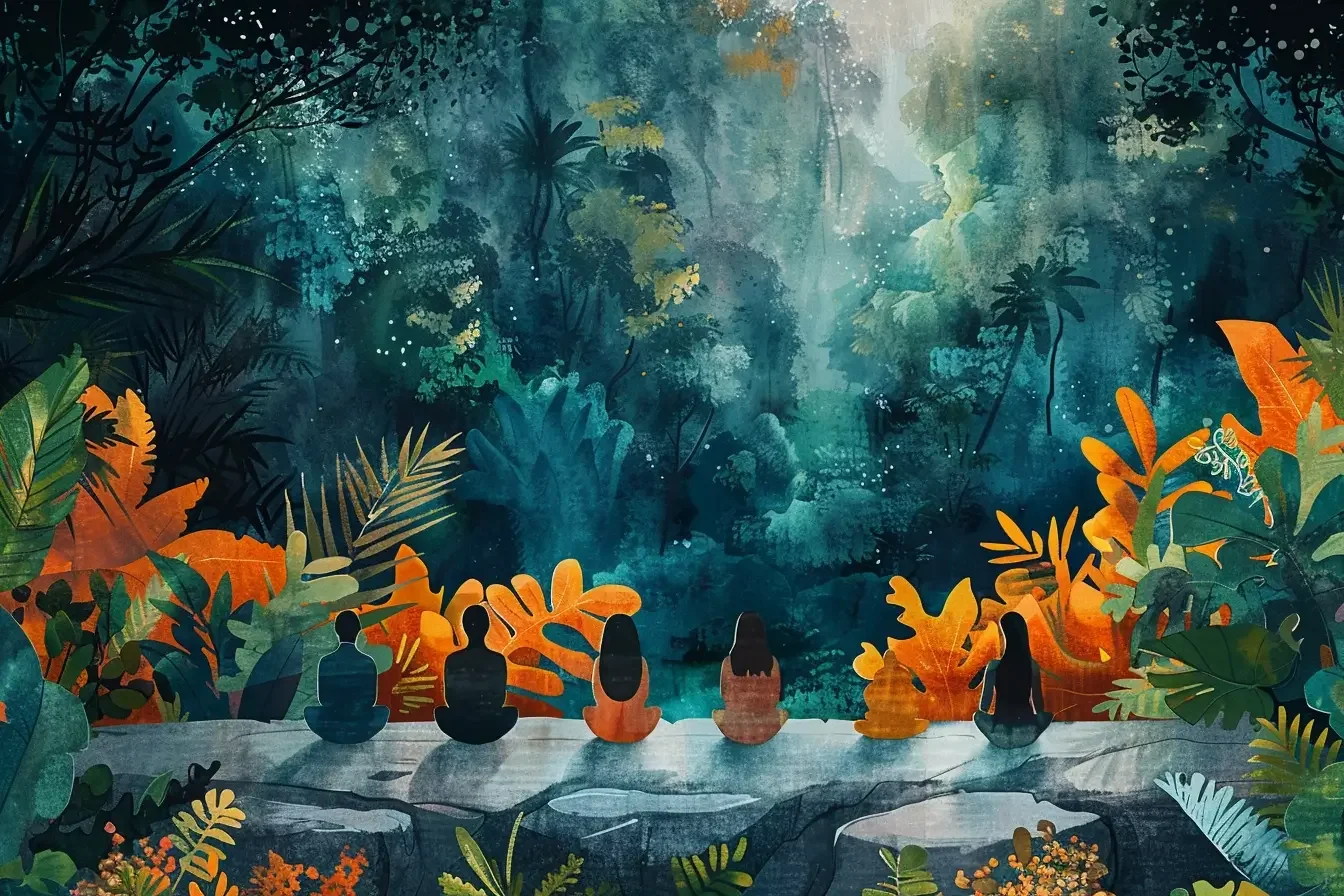
Hi all, I’m Tammy. There are many, like me, who believe that writing is a vehicle of creating connections, to oneself and others. The sense of isolation diminishes, even disappears. We do not want to live a life in a vacuum. Robert Frost said, “A poem begins with a lump in the throat; a homesickness or a love sickness. It is a reaching-out toward expression; an effort to find fulfillment. A complete poem is one where an emotion has found its thought and the thought has found words. ”Roger Rosenblatt once said, “We go through the arduous task of learning how to speak in order to tell the stories within.” The drive to say, “I am/was here” is hardwired in humans. This “drive” has been with us since we were aware of our “humanness.” The Indonesian handprints are at least 39,900 years old.

I am a believer that the creative process enables deeper critical thinking. It represents the highest level of Maslow’s hierarchy of needs; that being: self-actualization. There are many, like me, who write as a form of therapy; when the world does not make sense, when it is colder than icebergs, or when it shows a sign that there is hope. I hone the emotion in my personal lyrical poetry into a piece of highly polished art. The poem becomes a lantern for the reader, signaling someone understands and waits to embrace them.

I teach poetry because I know the healing power of words.

I know the human mind is poetic in nature. I know that with a handful of instruction and an armload of encouragement poems emerge from those who never thought they possessed the gift. I teach poetry because I understand the soul, in all of us, suffers and rejoices. I know the yearning to release/express. I, like my students, am like Keller, seeking the sight of words.

I have had the pleasure of serving as Suffolk County Poet Laureate (2009 – 2011) and the Long Island Poet of the Year (2017). I have devoted my adult life to poetry and having a location on Long Island that is open to anyone wishing to utilize it, is a vision forty years in the making that is now a reality that is the Long Island Poetry Literature Repository.

One of my most memorable experiences concerning poetry and its power is when I conducted “residency workshops” in the Suffolk County correctional facilities for five years. For the first three I would only hold workshops for the female inmates. One of the guards asked me to please include the male inmates. I relented and was ashamed after spending time with them. The men were in as much need to have a positive form of expression as the women. I was not, and still am not, Pollyanna about the inmates, but I also know the verse, “There but by the grace of God go I.”

In the fifth year I held workshops in two of Suffolk County facilities. I edited an anthology of their work, Finding Our Voices. Neither facility wanted to be associated with the other, one being the Riverhead County Jail and the other being the Day Jail in Hauppauge for drug and alcohol offensives. The Riverhead facility claimed that the day inmates in Hauppauge were nothing more than posers. The day inmates in Hauppauge said that the Riverhead inmates were all criminals. I found this separation of themselves from the other fascinating. I made sure each inmate received a copy of the anthology, which was partially funded by the Huntington Arts Council and BOCES.

The apex of my experiences, concerning the power of poetry, is the following story. Years ago, I had a poetry website. One of the contributors was a woman who I will call Mary. Her poems were getting darker and deeply depressing. I finally reached out to her and expressed my concern. She wrote back saying how she was an American stuck in Romania. She had sold all her belongings to join a man she had met online. He became abusive and broke her hand. She could not work, as she did not speak the language.

She said she had reached out to the United States Consulate; they would not help her. I asked if I could try to help her. Yes, she said. I called The Retreat, an organization that assists domestically abused women. They contacted the US Consulate on her behalf, next thing she and I knew, the consulate paid for her return ticket and The Retreat gave her shelter. A couple of weeks later I was the featured reader at a poetry reading in her area and asked if she would care to go. We met at a deli, as the location of the shelter was not to be shared. When she got in my car she said, “I’m scared.” Of what I asked. She replied of reading in public. I said, “After what you just went through, THIS is what you are scared of??” We both laughed. Several months later she moved to North Carolina to live with her sister. Many years later I worked at The Retreat as a Court Advocate.

I would like to think that poetry brought about what I mentioned at the beginning of this article: that writing is a vehicle for creating connections, to oneself and others. The sense of isolation diminishes, even disappears.


Tammy has earned her Ph.D. in Humanities & Culture in the Interdisciplinary Studies program at Union Institute & University. Her dissertation was: The Healing Power of Poetry. She teaches at Long Island University, at the C W Post campus, as an adjunct assistant professor in the departments of: English, Humanities, and Sociology. She is the Founder and President of Long Island Poetry & Literature Repository. She was the first female appointed to the post of Suffolk County Poet Laureate 2009-2011. She is the Editor of Long Island Sounds Anthology.

Some of her accomplishments: 2017 WWBP Long Island Poet of the Year; 2016 Charter Member of the Long Island Authors’ Circle; National Association Poetry Therapy Member (since 2015); 2012 – 2020 Poet-in-Residence Southampton Historical Museum; 2011 Nominated Pushcart Prize, “Beneath an Irish Sky” by Mobius; 2011 - 2014 Poetry Director of Youth Program in Ireland at the Gerard Manly Hopkins Festival; 2010 Mobius’ Editor-in-Chief Choice; 2009 Recipient of LIWG Community Service Award; Listed in Poets & Writers since 2006.


G&E In Motion does not necessarily agree with the opinions of our guest bloggers. That would be boring and counterproductive. We have simply found the author’s thoughts to be interesting, intelligent, unique, insightful, and/or important. We may not agree on the words but we surely agree on their right to express them and proudly present this platform as a means to do so.