trauma healing

The Psychedelic Poet

I’ll start with caution by saying that it’s still a surprise to me that I have been doing poetry for the last several years and that I have been recognized as a poet. It’s a surprise because I have been a comedian since 16 and five years ago, I went onto a spiritual path that has led me to explore my own healing through ceremonial plant medicine/psychedelics and mindfulness. So now at 33 I have surrendered into my own gifts with regards to the work of holding space.

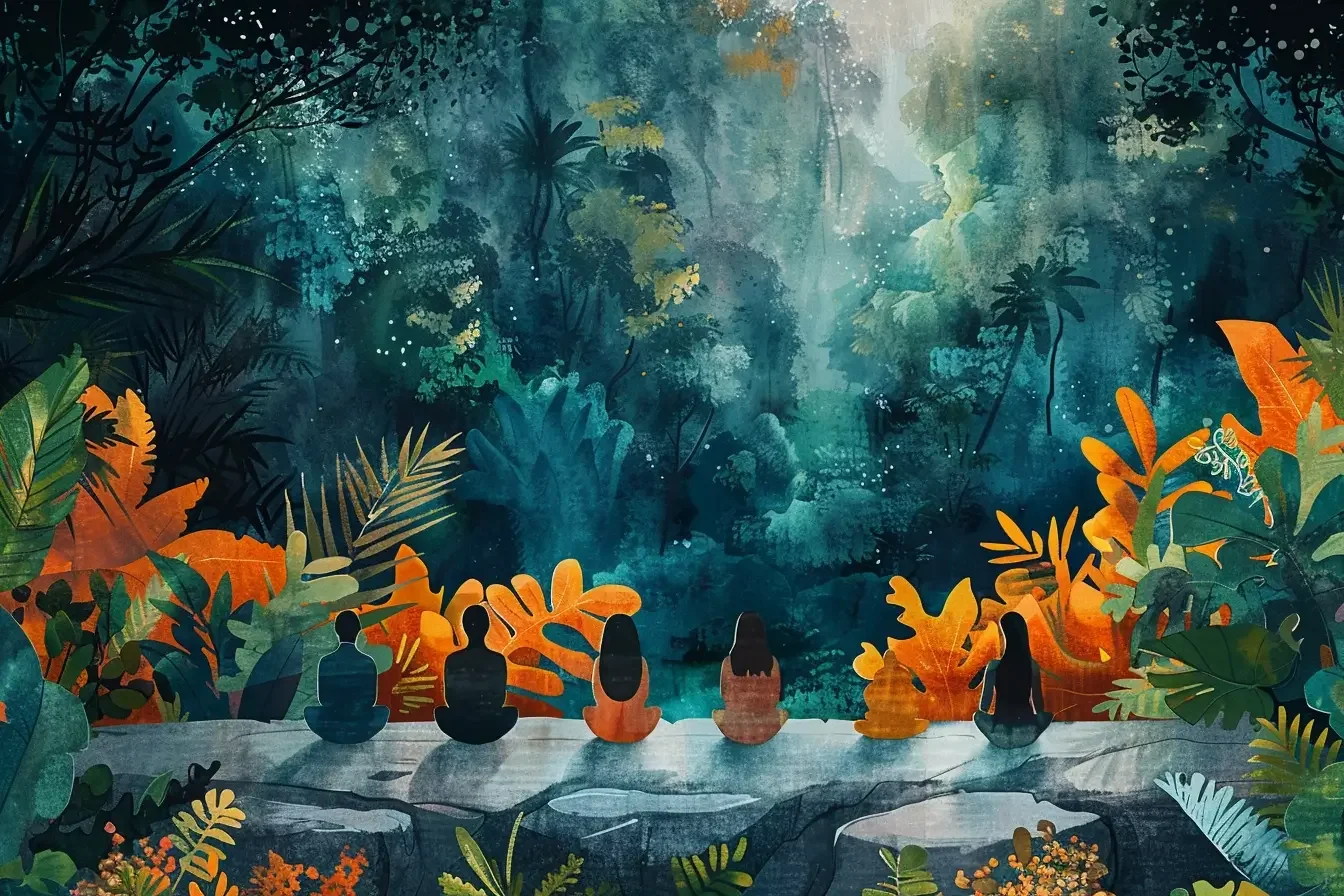
I can’t tell you about the different genres of poetry or give you a list of the most influential poets in history. I can’t write a poem based on a theme that you give me, or better yet I refuse. My grammar is seemingly nonexistent, my spelling still haunts me, and I never liked English class. Now here’s a few things that I do know…I know timing from doing comedy. I know how things should sound from my love of music. I know what I have seen in my own experiences with psychedelics, love and my relationship with the spirit realm. I know there is some invisible thread from the shamans, mystics, medicine men and women to the song writers, story tellers and poets.

I feel this lineage in a cosmic sense deep beneath my skin. And lastly, I always know where my heart is coming from. This is what gives me the confidence to step on stage along accomplished published poets and academics. I am not going up there to read a poem. I’m going up there to pray.

About two or three years ago when I was at a plant retreat while going through heart break I remember being around the fire with some of the guys and someone asked, “Does anyone know any poems?” My eyes went from staring into an abyss to him as if he just threw me a line to get back. I recited two poems of mine and then the third was Charles Bukowski’s “The Laughing Heart.” I’ll never forget one of my brothers in this community said, “Mike, when you spoke it was like the moon went out.”

As time went on and I kept going to the retreats, I started to then get asked if I could do a poem or two…this would always be spontaneous as the night went on and we were all very much feeling the plant medicine. In the beginning I remember how surprised and curious I was when I’d get asked. I was hyper-aware that I didn’t want to make it seem like I was taking over the space or getting too performative. This is a space I respect dearly; it is holy ground to me. But whether the community knew it or not they helped me get over this. Because every time people asked me, it was as if they gave me an invitation to step more into myself, my power, my own visibility and my own voice. I’ve read that in history, depending on the culture, shamans didn’t bestow that title upon themselves. Instead, they received that title only if their community saw them as such. I feel like my community at those retreats had given me the title of poet (and wizard being another one). Also, I think what surprised me the most was how it made total sense for me to be doing this; it’s a combination of two of my favorite things. Its sharing my words and holding space for people during their experiences. This was a beautiful handshake between the two.

In those moments it felt like the planets aligned.

I think one of the main reasons I was asked if I could write about this is to talk about what it’s like for me when I’m doing poetry for people in such spaces while I too am experiencing the medicine. And since I have been doing this a lot, I’ll try my best to share what it’s like only on my end.

I’ll be somewhere in the space, be it laying down or walking around checking in on people, and someone might bring up that I’m a poet. If it’s a moment where they don’t bring it up, but I feel something energetically calling me to share then I would ask if they would like me to do one for them that feels right based on how they tell me they are doing. I make sure to say it’s just an invitation, so that they can always say no or if they’re not feeling it’s the right time.

But if they do ask then this is what seems to happen. I usually find myself kneeling. I allow a bit of silence (that silence is where my words swim). I gather my mind trusting I will remember the words, and then I take a breath. It’s as if that breath is taking us into this poem, this small pocket of time, this realm, together. There’s no reading and I don’t feel like I’m reciting it…I’m simply allowing it. This may even look like I’m just having a conversation until you notice the words are rhyming. I’ll try to compliment whatever music is playing in the space. I do my best to lock into a pace that feels right for whoever I’m doing this with (not doing this “for” but doing this “with”). I know that like myself, their senses are very much heightened, so I become very aware of the rhythm, when to pause, and how my inflection is while letting my hands feel this energy. I don’t pretend to have any knowledge of what those hearing this are feeling. I can only control my intention. Letting each word out with love and a positive vibration behind it. I can even find myself getting a bit emotional because I am always reliving whatever inspired the poem in the first place.

Depending on the piece I often feel like each line is shedding more of me away…from my skin and my muscles to my bones to my soul and then releasing my spirit into the air. I always see those who I’m doing this with (be it at retreats, poetry mics, senior centers or a one-on-one) close their eyes and have this pleasant restful smile, slowly nodding it’s as if they “know.” It is a knowing that is magical and mysterious. Simply recalling these memories from my point of view, as I’m typing this, is making me tear up. It is an absolute honor for me to do this for people in those moments, and I am so grateful to have been called time and time again to share my words, my offerings. This is my service for my time here in the universe.

So, who am I now? What am I becoming? Comedian? Poet? Healer? Wizard? What the heck is all this?

I think a lot about George Carlin’s 1996 conversation with Charlie Rose. “Arthur Koestler said in The Act of Creation said that sometimes the jester can traverse the triptych. And if the jester says something funny, well, he’s a jester. If he says it in marvelous language that we say ‘oh isn’t that a nice way to put that’ then he’s a bit of a poet. And if there’s an underlying idea underneath the well-put funny line, if there’s a bit of a philosophy there, he comes something else again: a philosopher. Now one doesn’t sit and attempt do that with everything he writes but to know that that’s part of the package, to know that you can do these three things in varying degrees.”

With all that said, I look forward to continuing to honor this path that has found me. And to do my best to allow myself to grow further into this.


Michael Pagano

is a poet, mystic, and comedian who has been studying the magic of retreats for healing. His goal is to share his words on stage for larger audiences as well as leading his own retreats.

You can find him on TikTok and YouTube


G&E In Motion does not necessarily agree with the opinions of our guest bloggers. That would be boring and counterproductive. We have simply found the author’s thoughts to be interesting, intelligent, unique, insightful, and/or important. We may not agree on the words but we surely agree on their right to express them and proudly present this platform as a means to do so.

The Princess and the Pea

My daughter Maya sleeps in my painting studio. In the evenings I kiss her goodnight though she is 21. Maybe mothers always do that. I pass my hand over her forehead like I have done since she was a small child. Her brow no longer needs to be unstitched though. Her forehead is smooth. She is at peace, or just tired.

When I peek into the room it is often still early; she is either lying in the dark or finishing a movie, laptop propped upon her bent knees, on top of the blankets. One of them is a Pepto-Bismol-pink uncovered comforter. I suggested putting a cover on it but she resisted – and I suspect it’s more than laziness. It’s a down comforter that I have had since my single days. I used it uncovered myself because I didn’t know yet about comforter covers, in my 20’s, sleeping alone after my married lover had left for the night. My mother died too soon in my life to give me advice about what kinds of sheets to get, let alone what kind of men to date. I didn’t even know about putting bleach in a wash until after I had my own children. It had felt luxurious, buying that comforter, cover or not. The other blanket is dense cotton, a flat pale blue. My then-husband and I had gotten it for one of our earlier beds. Maya doesn’t want a sheet either; she prefers to sleep directly under both of these artifacts.

Once upon a time there was a prince who wanted to marry a princess; but she would have to be a real princess. He travelled all over the world to find one, but nowhere could he get what he wanted. There were princesses enough, but it was difficult to find out whether they were real ones. There was always something about them that was not as it should be. So he came home again and again and was sad, for he would have liked very much to have a real princess.

The pull-out sofa she sleeps on is stiff, a cheap Ikea model, steel-gray, a pole running through the length. She keeps it open, untidied. It doesn’t pay for her to redo the couch every day since I am not working in the studio right now. She says she doesn’t feel the pole, but I think she is telling me a white lie. I believe she feels it, but doesn’t want me to think she is uncomfortable.

One evening a terrible storm came on; there was thunder and lightning, and the rain poured down in torrents. Suddenly a knocking was heard at the city gate, and the old king went to open it.

She has set herself up in my studio because she does not want to revisit her past by sleeping in her bedroom again; I sleep in her room. She does not want to sleep in her brother’s old room, either, for fear it would signal some kind of permanence, or normalcy. In his room, the chestnut platform bed sits bare except for a white mattress-cover, and her cat who snoozes on the satiny surface. From the outside, it is ridiculous that she doesn’t sleep there. She has no real memories in that bedroom. Three of the six dresser drawers are empty. Luna, her cat, is already warming the bed. But even that, she explained, would imply that she was settling back in, which I interpreted as meaning that she would not be the different, newly hatched creature she needs to be.

It was a princess standing out there in front of the gate. But, good gracious! what a sight the rain and the wind had made her look. The water ran down from her hair and clothes; it ran down into the toes of her shoes and out again at the heels. And yet she said that she was a real princess.

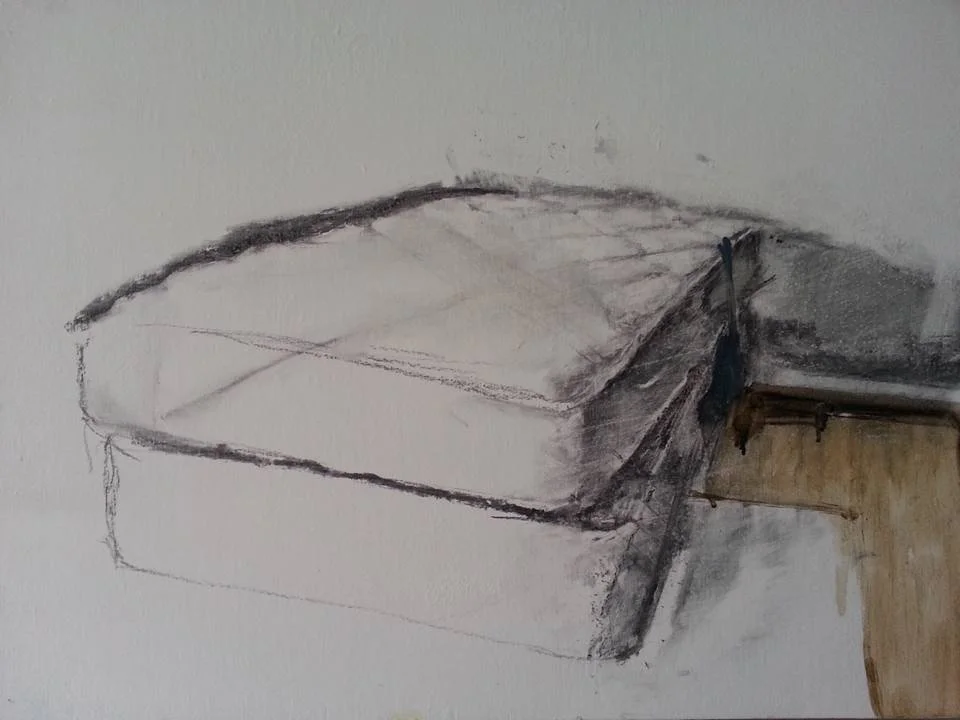
Sleeping in her bedroom would, she fears, mean she is still the girl who dwelled inside the four walls of her rape. She would be encircled, again, by the rape. Instead, she sleeps within the womb of my paintings. For now, she is neither the Maya of her earlier years nor a freshly revealed being. She waits within this multi-hued, slightly oily-smelling space, an in-between time. Paintings of every size lean against the walls surrounding her. At night, she peers over the edge of her laptop to the angles of honey-wood stretcher-bars that frame whatever she watches. She sleeps amidst work from the different times of my life as an artist; she sleeps within my past, next to visions whose original meanings are largely forgotten, or are irrelevant.

“Well, we’ll soon find that out,” thought the old queen. But she said nothing, went into the bed-room, took all the bedding off the bedstead, and laid a pea on the bottom; then she took twenty mattresses and laid them on the pea, and then twenty eider-down beds on top of the mattresses.

She also sleeps next to a triptych that still pulses with its violent story: a painting of a rape. They hang one next to the other just above the couch bed, not turned to the wall. When I go into the room at night, I see her face illuminated by the computer’s glow. And, in that technological twilight, those paintings. What is exposed during the day: the tangle of bedding and the rape paintings; a painting of bodies on a raft done when we were figuring out how to survive; a painting I did of my middle-aged belly – a drawing of my son as an enraged adolescent glued to the upper-right corner. Nights, the rambunctious images slumber, save the rape paintings, which catch the glow of streetlights long after her laptop has been shut.

On this the princess had to lie all night. In the morning she was asked how she had slept.

She sleeps by this shared history that will always, likely, remain crepuscular. I painted the rape triptych towards the end of the legal procedure following the charges she pressed against the rapist. The case now over, we are back home; she sleeps within my work like a fetus; she percolates not in my body but in my work, in the body of my work. She didn’t move back home; she moved into my work.

“Oh, very badly!” said she. “I have scarcely closed my eyes all night. Heaven only knows what was in the bed, but I was lying on something hard, so that I am black and blue all over my body. It’s horrible!”

There is a small glass-topped desk beneath two corner windows, just behind the side of the bed where she places her head. A pile of computer paper leans Pisa-like to the left of the rolling chair, another stack on top of the glass, another stuffed into the shelf underneath. They are all drafts of my recent memoir, about the rape from my – the mother’s – perspective. Maya sleeps next to all of it. Scattered pages blow off the most recent version when she opens the window before bed, littering the floor. White tiles speckled with type. She leaves them, the fanned paper making a half-halo seen from above, as she sleeps, waiting for either the full to arrive or the vanishing of the half.

Now they knew that she was a real princess because she had felt the pea right through the twenty mattresses and the twenty eider-down beds.

Maya graduated from college last May, after finding out that she lost the case. Her valises line the wall where I normally prop my paintings while working. Clothing drapes across suitcases and boxes. One splayed heap is a collaged dirty-laundry mix of jeans, a blue striped sleep-shirt, beige linen pants, a teal turtleneck. Against the wall behind that jumble is a roll of paper on which I began a drawing. It also waits. I called this work an “infinite drawing” two springs ago, when I began it, implying that I would work on it forever – that it would never be done. They are both incubating, Maya and the drawing. Last week one of her new white t-shirts got charcoal on it that doesn’t seem to wash out. There’s always something on the floor that stains clothing. It is all infinite in this room, which is maybe the real reason Maya has moved in. She is surrounded with the kind of love artists learn to gel into paintings. She can’t stay there forever, but she can borrow it, the room and the infinite looking, for a while. And I can wait until she’s ready to move out. The bed I use in her old room has a fairly new hybrid memory-foam mattress. It is the most comfortable bed in the apartment, and I have a sore back.

Nobody but a real princess could be as sensitive as that.

Initially, she had brought the standing mirror from her old room into the studio, and leaned it against the framed edge of a portrait of her brother. Whenever I noticed, I inched it away from the painting, but would find it there again after a few days. Last night it was back in her bedroom. She might be getting ready to leave. Or maybe she doesn’t need to see herself any more.

So the prince took her for his wife, for now he knew that he had a real princess; and the pea was put in the museum, where it may still be seen, if no one has stolen it.

Maya says she has never been happier than the time she has been sleeping in my studio. This time of her deepest sleep, after the end of the rape case. She doesn’t shut the shades, so the morning sun helps rouse her. It – the case – and she – remain preserved in amber light, until she wakes looking out over the supplies I use to make new worlds.

There. That is a true story.


Karen Kaapcke

is an award-winning visual artist whose work is included in many private collections. She has exhibited broadly, both in the US and Europe. Notable awards include first–place for self-portrait at the Portrait Society of America, and finalist for the prestigious BP Portrait Award, where her painting was exhibited at the National Portrait Gallery, London. She recently completed a memoir about mothering her daughter through a rape, subsequent illnesses, a trial in France, and both of their recoveries. Karen maintains studios in New York City and France. More about her painting can be found at www.karenkaapcke.weebly.com


G&E In Motion does not necessarily agree with the opinions of our guest bloggers. That would be boring and counterproductive. We have simply found the author’s thoughts to be interesting, intelligent, unique, insightful, and/or important. We may not agree on the words but we surely agree on their right to express them and proudly present this platform as a means to do so.