


La chute d’lcare Pieter I BRUEGEL (BRUEGHEL)
Ca. 1527/30 - Bruxelles 1569
Musées royaux des Beaux-Arts de Belgique, Bruxelles / photo : J. Geleyns - Art Photography
After all these years. Finally, here I am. Face to face with you. In the flesh. You, fine example of Flemish Renaissance. You, precursor to the Baroque. You, you perplexing driver of thoughts. You’ve been an inspirational thorn in the side of many.
In the Royal Old Masters Museum in Brussels, like W. H. Auden and many others before me, I stand in front of the work, Pieter I. Bruegel’s Landscape with the Fall of Icarus, the painting I have taught throughout my career as an English professor in mythology and literature classes but have only seen in slides. I’m with my sister on vacation in Belgium. Because she has nerve damage in her feet, it’s hard for her to tour museums, so I push her through the building in a wheelchair, which ensures I have a captive audience at this moment. I set her up in front of the painting, explaining the significance of this meeting for me.
What follows is some of what I told my sister—augmented with much of what I have taught and thought for many years. You might wonder if seeing the actual painting changed my appreciation for it in any way, and I would have to say, probably not. But I don’t mean to suggest an anticlimactic experience. It was more akin to the ideal culmination of a pen pal relationship: the other of your correspondence turning out to be exactly what you imagined and hoped for. No finding out you were catfished. No crushing disappointment. No feeling of, “meh,” as so many people report with the Mona Lisa in the Louvre. Then again, I wasn’t fighting a bus-load of tourists with cameras flashing, standing 50 yards away. I was up close and personal, capitalizing on an intimate relationship that took a good portion of my life to cultivate.
I tell my sister what I’ve told my students. The best way to begin is to play treasure hunt. Where’s Icarus? The painting features a well-dressed burgher in the foreground, plowing a field in tandem with an equine, head bowed as he tills the soil. He’s the main event in the composition, enlarged and bedecked in complementing red and green to showcase his resplendent costume. In the background, a landscape of sea and sky, sun and ships opens to a wideness that dwarfs the human players. If you are persistent, though, you will find, towards the right corner off the shoreline, a pair of small kicking legs indicating an inverted figure breaking the water surface. This is the fallen Icarus—faceless, drowning—insignificant, it seems, in an event in which you imagine him center stage.
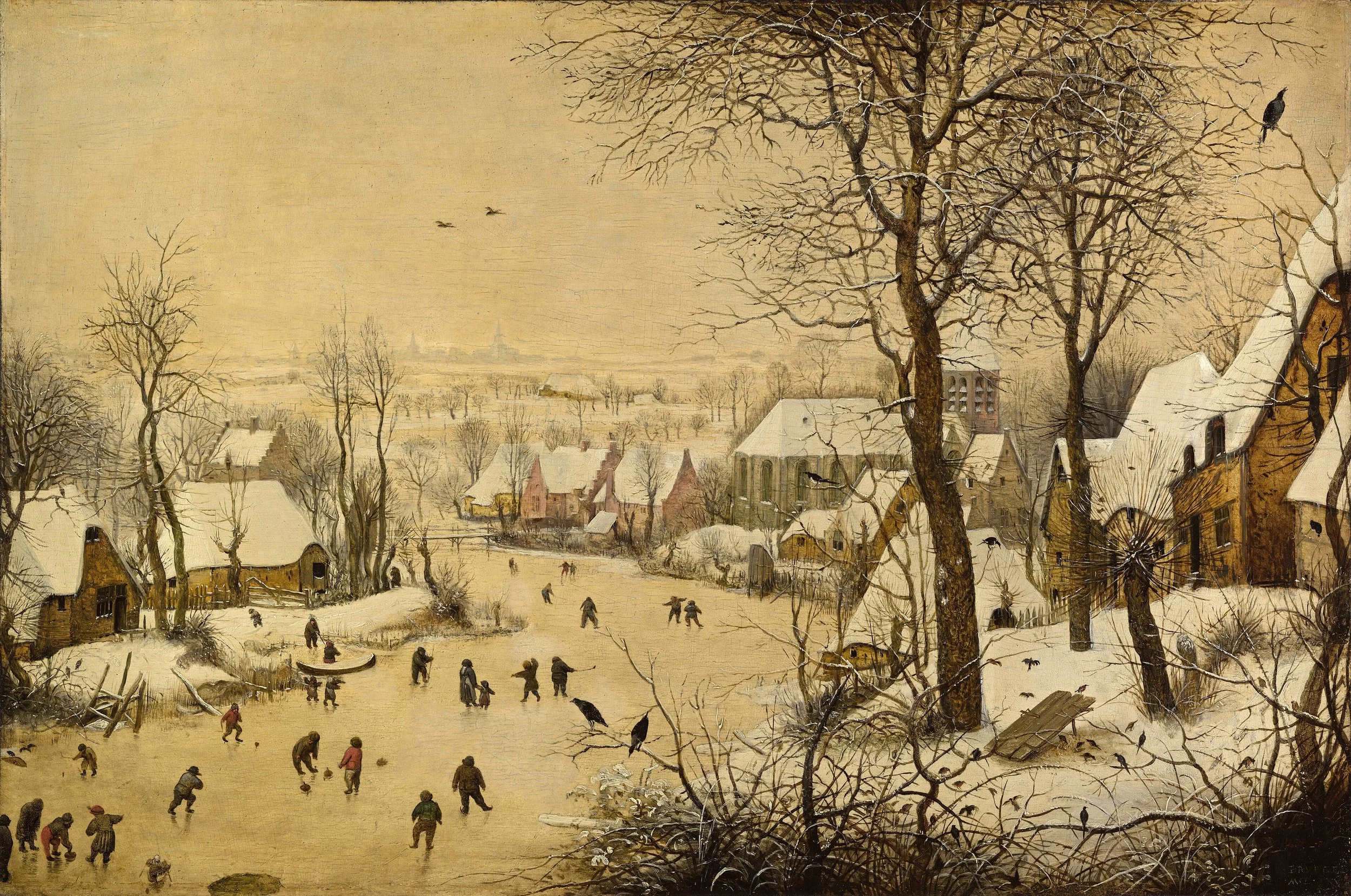
Your first reaction to your discovery might be to laugh. Expecting the tragedy we associate with Ovid’s story of the boy who flew too high and fell too far, the viewer instead is treated to the comic absurd, that is, Bruegel’s absurd, which, like Hieronymus Bosch’s, is a bit sinister. A good illustration of what I mean is found in another Bruegel painting, The Bird Trap, a delightful snow scene of skaters that includes, off to the side, the device of its title. The idyllic narrative of the everyday is disrupted by the implied impending capture: the crushing of the songbirds that have gathered to feed at the baited trap. The necessary violence that underwrites the quotidian joys of existence is unremarked, but it is there, subtly infused through every strand of the commonplace. The enabling constraint of static depiction inherent in the genres of painting allows Bruegel to achieve the effect. We are stuck in the narrative frame before the trap is sprung, thus rendering the violence implied rather than accomplished, evoking sensations in us of the uncanny rather than simple horror.
The same can be said of the Icarus painting, only in this case, my attention diverts to the action preceding the static moment of Icarus’s fall. What were the other denizens of the scene doing prior to the great failure? In Ovid’s poem from the Metamorphoses, the most widely known source for the story, he focuses on that action, describing the shock and amazement at seeing a young boy in flight. But Bruegel’s ironic referencing and warping of Ovid takes us to a darker place. His characters respond in exactly the opposite way from the poet’s. Rather than watching aghast the tragic flight unfold, Bruegel’s ploughman, shepherds, and sea-faring vessels either never even see the young boy or, having seen, turn away to carry on with their lives, uninterested, unimpressed, or seemingly unable to intervene. We cannot know which, but the differences are arguably crucial in how we view our own agentive capacities as well as our fellow humans with whom we share this earth.
In his ekphrasis “Musée des Beaux Arts” (1938), Auden presumes to answer the question for us, or we think he does. The poem’s speaker, taking in the plenitude of the museum’s collection, announces “About suffering they were never wrong,/ The Old Masters: how well they understood/ Its human position,” and then directs our attention to the specific example in “Breughel’s Icarus” that the speaker is pondering:
. . . everything turns away
Quite leisurely from the disaster; the ploughman may
Have heard the splash, the forsaken cry,
But for him it was not an important failure; the sun shone
As it had to on the white legs disappearing into the green
Water; and the expensive delicate ship that must have seen
Something amazing, a boy falling out of the sky,
Had somewhere to get to and sailed calmly on.
While Auden hedges on the ploughman, he is convinced that the sailors must have seen Icarus yet continued on their way, commerce’s exigency taking precedence over a singular human life. Given the year of publication, readers sometimes conclude that Auden is commenting on a populace’s apathy in the face of rising fascism, concerned with their own lives and not the in-progress atrocities and loss of our collective humanity. This interpretation, while plausible, is heavy-handed and moves us away from the subtle frissons of Bruegel’s narrative. To be fair, such a view of “Musée des Beaux Arts” disallows an ambiguity that Auden’s words themselves preserve. Rather than deliberately turn away, the ploughman may not have seen Icarus at all. In other words, he may have missed the entire air-borne spectacle.
Why?
The poet Michael Hamburger offers a reason in his more recent “Lines on Brueghel’s Icarus” (1984): “The ploughman,” he tells us, simply “ploughs.” The speaker describes a routine existence that does not permit viewing what in Auden’s poem is “something amazing.” Hamburger goes on to describe sailors and shepherds, even sheep, whose lives are so narrow and exclusionary as to disallow the ability to see or comprehend feats of the ancient champion defying “the ordering planet.” This, then, is less about apathy and more about stunted growth and limited possibilities. The ploughman has been so spiritually and emotionally impoverished by his chronic furrow-making that he is incapable of looking up and appreciating the wondrous—or someone engaging in the impractical, which indeed is what occurs when Icarus turns his flight into an epic achievement rather than a means of desperate escape. The ploughman’s sensibilities are literally in a rut, and his plough is for him what our phones are for us today: the device that keeps us from noticing what is happening around us.
Unlike Auden who focuses on human suffering, Hamburger is interested in portraying the heroic difference between Icarus and others. But in doing so, he also curtails the possibilities presented by Bruegel. There is more than a touch of condescension in Hamburger’s treatment of the scene’s laborers, which is arguably not part of Bruegel’s vision. Instead of a hopeless world bereft of compassion or empathy, Bruegel’s focus on the ploughman could just as easily suggest a reverence for life and survival. Was Icarus’s act of defiance heroic or merely self-indulgent, and if the latter, can we then view the ploughman as a sustainer of life whose homely work brings forth food from the earth to nourish the human race? Unlike the obtuse refuseniks in the contemporary movie Don’t Look Up, who belligerently disregard the evidence of their own senses, our ploughman and his earth-bound gaze may embody a kind of authentic persistence in a world filled with sensational distractions. After all, we might ask about the nature of Icarus’s so-called achievement; whether he is a mover of boundaries or merely a thrill- seeker. Not that the two must be mutually exclusive.
When Melania Trump visited a migrant children’s detention center in Texas wearing a jacket with the now infamous phrase “I don’t really care. Do U?”, many of us were appalled by the tone-deaf choice. It was difficult not to experience this symbolism as insensitivity to suffering children separated from their desperate parents, despite assurances from the First Lady to the contrary. But I have wondered whether, in another context and projected from a different ethos than FLOTUS inhabits, the phrase on the jacket might have hit different. Instead of callousness, the refusal to care about the judgments of others can be a productive defiance, as much as it might be a childish rationalization to evade standards of decency. On the other hand, refusing the rapture of the sensational is another kind of rebellion. The ploughman’s conformity is not mindless but good judgment, something the dare-devil Icarus failed to display. The ploughman has stuck to his task and won the day. He endures with his feet on the ground. There’s no need to buy into the dualistic conceit that lofty aspirations are any more worthwhile than what terra firma has to offer.

But Bruegel’s ploughman as a contemporary well-to-do citizen, placed anachronistically in a mythic structure, may not align with such a wholesome view. His fancy dress, distancing him from the peasantry, makes him less the salt of the earth and more a prosperous farmer taking advantage of the profits to be made from agriculture under capitalism. The economy is thriving, and so is he. In the modern world, there is no longer need or room for the ancient hero and his tales. We truly don’t care about Icarus. Icarus never had the chance to grow up, but we have. Nostalgia, who needs it?
Well, maybe poets like Hamburger. Hamburger lauds Icarus as an “angel” in contrast with the “churlish” folk who people the world, a dime a dozen. James Joyce, along with the poet Anne Sexton, saw Icarus as the artist who flies higher and sees more than the rest of us left below on the ground, purblind and numb. The romantic view, if elitist, even narcissistic, is hard to resist—unless, like Bruegel, you find a bit of pleasure in the perverse. Of course, we might see the glorification of a doomed venture as its own worthwhile perversity. So it is with Sexton’s “To a Friend Whose Work Has Come to Triumph,” a sonnet inspired by the Icarus legend (as well as Yeats’ “To a Friend Whose Work Has Come to Nothing”) but not, as far as I know, by the Bruegel work. For Sexton, failure is not an option for Icarus because there is no failure, only a steep price to be paid for the great privilege of achievement. Delightfully, Sexton takes us full circle when her poem asks of Icarus: “Who cares that he fell back to sea?” This is not the same question of care that an absorbed ploughman poses for us or a clueless First Lady.
Instead, it is a defiant declaration of “triumph.” We might imagine George Clooney’s character, Jay Kelly, someone who sacrificed personal ties for fame, taking solace in Sexton’s couplet: “See [Icarus] acclaiming the sun and come plunging down/ while his sensible daddy goes straight into town.”
Sexton invites us into full-on tragic mode, complete with fall, the pleasure of which Bruegel potentially seeks to rob from us. Milan Kundera says that tragedy saves us because it provides us with the illusion that we matter; we are important enough for our failures to count. From The Art of the Novel (1986): “By providing us with the lovely illusion of human greatness, the tragic brings us consolation. The comic is crueler: it brutally reveals the meaninglessness of everything.” As a Czech writer who lived in exile during the Cold War, Kundera was preoccupied with the hair’s breadth that often separates tragedy and the comic absurd and how one easily transforms into the other. In the second quarter of the 21 st century, we know about this all too well; we hover in the nowhere of disbelief, between laughter and tears. We watch comedians mine the unrelenting news cycle by parodying events that are already parodies of themselves. We witness those who dictate our destinies, wearing large hats and clown suits while they crash the clown car which, it turns out, contains our lives.
Bruegel also knew this territory of bitter irony that, if we were inclined to bottom-line it, might be summed up in the expression, “funny/not funny.” After we laugh at those silly flailing legs of our fallen Icarus, we realize the joke is on us. We are left with the messy work of sorting out what is lost and what remains and what, after all, we are to do about it.

Wendy Ryden
is a retired Professor of English, Long Island University, Post campus.
G&E In Motion does not necessarily agree with the opinions of our guest bloggers. That would be boring and counterproductive. We have simply found the author’s thoughts to be interesting, intelligent, unique, insightful, and/or important. We may not agree on the words but we surely agree on their right to express them and proudly present this platform as a means to do so.