

Sociologist Erving Goffman argued that every social action is organized around performance: roles, scripts, stages, costumes, and masks. In Minnesota, the recent deployment of federal immigration agents has revealed how dangerous that insight becomes when enforcement slips from public service into theater.
Immigration and Customs Enforcement was created to enforce immigration law, not to operate as a public-safety agency in densely populated neighborhoods. Yet under the current enforcement surge in Minneapolis, ICE agents have assumed precisely that role. They are armed, uniformed, and empowered to make split-second life-and-death decisions on city streets. The result has been a series of fatal encounters, including the killings of U.S. citizens, that expose the deadly consequences of turning civic authority into performance.
Cultural scripts amplify this danger. Generations of Americans have grown up immersed in simulated combat—video games where hesitation is punished, morality collapses into a kill or be killed environment, and avatars reward aggression. Players rely on speed and decisiveness, not reflection and restraint. When ICE agents shaped by these virtual scripts enter real-world enforcement, the lessons of the game can collide tragically with the moral and tactical demands of policing civilians.
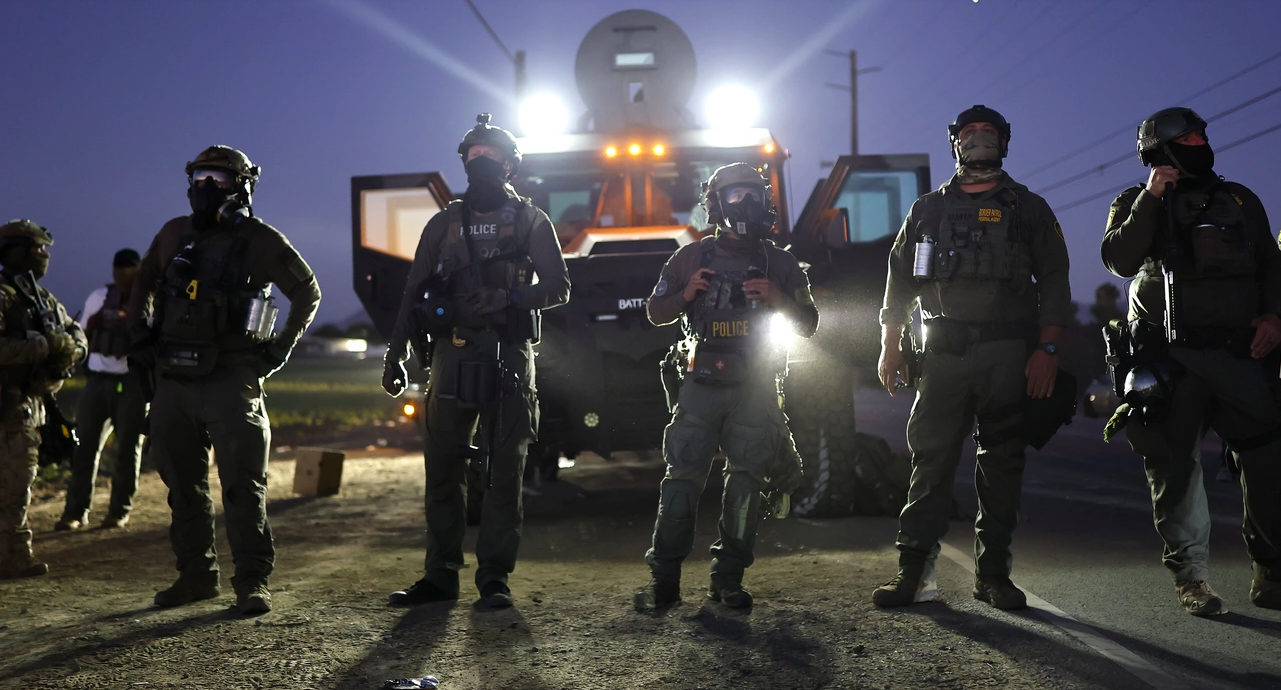
The ICE uniform compounds the problem. Tactical gear, weapons, and badges do more than equip officers; they function as a mask. Behind it, individual responsibility blurs, empathy dulls, and civilians are more easily reduced to threats. The agent becomes a character in a high-stakes performance, where escalation is scripted, and hesitation is failure.
These patterns have real consequences. ICE agents are trained for detention and compliance, not for civilian policing in volatile public spaces. Paired with militarized costumes and cultural scripts that valorize aggression, the role leaves little room for patience or reflection. Waiting becomes a weakness; escalation becomes inevitable.
Alternatives exist.
Agents can create distance instead of closing it. They can disable vehicles instead of firing into them. They can wait for backup, clarity, or for tension to dissipate instead of grabbing their guns. The scripts these men are permitted to follow have no repercussions, therein lies the tragedy. The avatar hides everything.
Minnesota demands more than accountability after the fact. It demands a reconsideration of the role itself. When federal enforcement is staged as a performance of power, when cultural scripts normalize decisive violence, and when the uniform becomes a mask that obscures moral responsibility, tragic outcomes are inevitable.
Public safety is not theater.
It is a civic responsibility that requires humility, restraint, and the courage to step offstage. If we cling to the mask of authority, violence will not be the exception—it will be the expected ending.

Andrea Stulman Dennett

earned a B.A. from Tufts University and a Ph.D. from New York University’s Department of Performance Studies. She studied under Brooks McNamara, Richard Schechner, and Barbara Kirshenblatt-Gimblett. She spent nearly two decades teaching graduate-level Performance Theory, dedicated to reshaping how performance is understood and experienced.
G&E In Motion does not necessarily agree with the opinions of our guest bloggers. That would be boring and counterproductive. We have simply found the author’s thoughts to be interesting, intelligent, unique, insightful, and/or important. We may not agree on the words but we surely agree on their right to express them and proudly present this platform as a means to do so.