Good Idea, Bad Timing

I’ve been writing screenplays for decades, but I have yet to sell one. I’ve had some close calls, and I’ve been hired to do assignments, but I’ve never sold a spec…

…SO far.

Instead, I keep at it, in spite of an annoying pattern that should have put me off of writing forever. It’s a pattern that all writers can relate to; every scribe I’ve ever spoken to has similar stories to tell. 

The pattern? Good idea, bad timing. Let me cite a few examples… 

In the early 1990s I decided that, since I loved the Universal horror movies and there hadn't been a serious Dracula movie since the 1979 John Badham version (which I loved), I would write one (and yes, I’m aware that Dracula was a leading character in 1987’s Monster Squad)

 My bright idea was to make it like 1958’s It! The Terror From Beyond Space or 1979’s Alien (which I always felt was kind of a big-budget remake of the low-budget 1958 film) with a monster terrorizing people in a confined space. So naturally, I thought: why not write an entire script just about Dracula's voyage from Transylvania to England? I used the chapter in Bram Stoker's novel that detailed the doomed voyage of the Demeter as a jumping-off point, but added a woman and her child into the mix; they come under Dracula's spell as he slowly decimates the crew (an idea inspired by the Candice Bergen-Sean Connery relationship in 1975’s The Wind and the Lion).

I finished the script in 1991, and sent it to an agent at the Gersh Agency whom I had briefly worked for as an assistant. And right at that time, it was announced in Variety that Francis Ford Coppola was making a new version of Dracula (released a year later as Bram Stoker’s Dracula, from a script by James V. Hart, who began writing it in 1977), so the agent felt there’d be no interest in another Dracula script for some time. 

After some years had passed, I thought of putting the script out again as a potential cable movie, or even turning it into a novel. Then in 2012 I heard about the novel Dracula's Demeter and the film adaptation of it that was in the works; since that time I also keep hearing about the potential The Last Voyage of the Demeter, a film which has been in pre-production for years. So my script sits on a bookshelf in my apartment unread and unrealized, alongside another example…

In the mid-1990s, a couple of years after the Dracula disappointment, I wrote a script about 1920s Arctic explorers, based on a true story. I thought Matthew McConaughey would be great for the lead role and had a producer friend get the script to him. He liked it, but felt he was a bit young at the time to play the lead character, who was in his 40s (a decade older than McConaughey at the time), so he passed. But he did say he'd be open to seeing more of my work, so thinking about what kind or role would be appropriate for his persona, I wrote a script about an Evel Knievel-type motorcycle daredevil. Just as I finished it, I read in Varietythat the next film from Rob Cohen, director of Dragon: The Bruce Lee Story, would be a biopic about Evel Knievel..... and attached to star was Matthew McConaughey. 

When a few years had passed and that film hadn't gotten off the ground, I thought okay, let's rewrite the script and try it as a Showtime or HBO movie. And just as I finished the rewrite, I read that TNT was doing a TV movie about Evel Knievel starring George Eads, which did get made. 

Again, right idea, bad timing - twice. 

And then there was that time that I thought a movie about tornado storm chasers would be a good idea, until this guy named Spielberg announced his next project would be a film called Twister...

These are just a few examples. There have been others. Many others. And I know it’s not just an isolated phenomenon that happens only to me. Some years ago, one of my friends had an idea about the toys of a child that come to life and experience all kinds of adventures when the kid is out of the room. No sooner had they told me about it than Pixar’s Toy Story was released. And one of my bosses at Nelson Entertainment was working on a spec animated musical about ants, until… well, you know.

So what’s going on here? Is every screenwriter’s home/apartment/phone in Los Angeles and vicinity bugged so execs can steal their ideas? 

It's one of those things about which I used to warn my scriptwriting students: there are certain ideas that just simply ride the zeitgeist, floating through the air like radio waves, and as writers, we always have our story antenna up, so it's not uncommon that several different writers will tune in to the same - or a similar - idea. 

That’s how competing King Kong remakes were announced almost simultaneously in the mid-1970s (Universal’s was put on the back burner, while Dino DeLaurentiis’s became one of my guilty pleasures). A couple of father/son body-switching movies were also released around the same time (Like Father, Like Son in 1987, Vice Versa in 1988), and two Robin Hood movies competed in the early ‘90s (Kevin Costner’s made it to theaters, while Patrick Bergin’s went to Fox TV), and so on and so forth.

I could give a dozen examples of how I've begun developing ideas or even written full scripts only to learn that an almost identical project has been sold or gone into production. You’d think it might be discouraging, but I love writing too much to give up just because synchronicity exists. 

I find some comfort in this thought: my instincts are good, only my timing is lousy. 


So far…

Bruce Scivally has worked as an editor, producer, writer, director and even special effects assistant on music videos, TV specials, feature films and documentaries.

He worked in the business affairs departments of Nelson Entertainment, Sovereign Pictures and Cinergi and is the author of the books Dracula FAQ, Billion Dollar Batman, Superman on Film, Television, Radio and Broadway and co-author of the book James Bond: The Legacy with John Cork. Currently, he is one of the producers of The Miracle Show for Questar Entertainment.

G&E In Motion does not necessarily agree with the opinions of our guest bloggers. That would be boring and counterproductive. We have simply found the author’s thoughts to be interesting, intelligent, unique, insightful, and/or important. We may not agree on the words but we surely agree on their right to express them and proudly present this platform as a means to do so.

The Aesthetic Experience of Observing Dance

Over the course of my dance career, I’ve heard many non-dancers make interesting remarks while reflecting on a dance performance they just watched. They would say things like: 

“Wow, I enjoyed the show so much…I felt every single move!” 

“Didn’t expect to enjoy it as much as I did. The performance really moved me.” 

“Couldn’t understand the concept behind the piece but it was pleasing to watch.” 

“I did not understand anything that was happening and I could not connect to it.”  

All of these statements are valid responses from audience members. However, has anyone ever stopped to ask the following questions: 1. What actually caused them to have this response? And 2. What factors affected their overall experience?

While exploring the phenomenological experiences that take place within dance, it is interesting to consider the observer’s experience while watching a dance performance. Observing movement is more than just an observation of several visual images in motion. It is an outer body experience. Some may think that the dancer’s experience in the acts of performing, choreographing, rehearsing, and/or improvising, differs completely from the experience of a person who is simply just observing. However, there are some similarities between the two. 

Dance is meant to conjure up an aesthetic experience for the observer, just as it is for the dancer or choreographer. It is usually created with the intention of causing the viewers to have a cultural, emotional, and/or meaningful response. While viewing a dance performance, audience members are forced to do more than just observe with their eyes.  They must use their perception, which goes past the typical gaze or stare. This means that they are forced to interpret and find meaningful value within the art they are currently experiencing. It can almost feel like a heightened, artistic, sixth sense.

Picture8.jpg

 When people go to see a dance performance, their expectations and feelings towards dance itself, can influence their overall experience and shape their perception of the performance. For example, if someone who is only interested in Hip Hop goes to see a Ballet, the experience they have while watching, and their interpretation of it, may differ from a person who favors Ballet. This doesn’t always mean they will disengage because of a lack of interest. Oftentimes people unexpectedly end up enjoying dance performances they were not interested in at first. However, in some cases, it is harder for the observer to fully digest something that is uninteresting to them or completely foreign. 

Based on my observational experiences within dance, I’ve discovered that prior information and viewer interest heavily influences the observer’s experience. Usually, I am almost certain of the experience I will have while attending a performance for a specific dance company or musical. The assumption I make is usually based upon my interest in the style or type of dance that I am going to watch. Also, if I am not familiar with the work of the choreographer or style of dance, prior reading or research would definitely influence my interest as well as my experience. 

In the article Dance Choreography and the Brain, Dutch choreographer and researcher Ivar Hagendoorn provides some reasoning for why this happens. “Experimental psychologists use a technique called priming to study how prior information in general, and unconscious attitudes in particular, bias people’s perception and judgment.” 

 In a separate article entitled The Dancing Brain he further explains: “Appreciating something cognitively and enjoying it emotionally are not the same. Each person’s individual experience of a dance performance is the product not just of perceptual processes, but also of their interaction with memories, associations, and personal preferences.” 

The phenomenological experience of observers is not just shaped by what they are processing visually at the performance but by their preconceived interests, information and expectations concerning the type of dance they are about to see.

When people watch dance their responses and/or feelings about the movement are also dependent upon their ability to comprehend and follow the piece. It can be hard for a person to fully understand the movement they are observing if they do not comprehend the feeling, experience, or true meaning that lies underneath the creation of the movement. Also, it may be hard to understand a movement that is specific to a culture with no prior knowledge, context, or understanding of that vocabulary. 

Collecting research, or actually undergoing the physical experience of art that is unfamiliar, provides the observer with a better outlook on the true meaning and purpose. In Variations on a Blue Guitar, Maxine Greene compares this experience to meeting someone new. When a person is meeting someone else for the first time, “the proper way to encounter another person is to be open to them, to be ready to see new dimensions, new facets of the other, to recognize the possibility of some fresh perception or understanding, so you may know the other better.” 

This concept can be applied to experiencing unfamiliar art for the very first time. Collecting prior information and taking interest in physically experiencing the style of movement can greatly influence and heighten your phenomenological experience while observing a performance. When the body is put through the actual motions and engaged in the movement being displayed, it provides a unique bodily experience that cannot be duplicated through words.

On the contrary, collecting prior information or having interest in a specific choreographer or dance company can lead to the development of expectations. This simply means that the same phenomenological experience is expected whenever individuals watch a performance from a dance company they thoroughly enjoyed. If people see a great performance, they expect to have the same experience when they see another piece by the same choreographer. However, if they are bored and do not enjoy the performance, their expectations are downgraded and they have trained their perceptual expectations. The observer’s experience can also affect choreographers while creating new work; they may either try to replicate the same emotionality of a previous work or they may explore another direction. This is the risk a choreographer has to take.

When the true depth of the movement is understood and appreciated, it enhances the observer’s response to it. For example, some observers may find themselves unconsciously dancing in their chair while watching a performance. Why? Because the brain is stimulated and the observed movement is causing the observer to have an outer body experience. 

In Some Speculative Hypotheses about the Nature and Perception of Dance and Choreography, Hagendoorn touches on this point. He hypothesizes that while observing dance, the brain is submerged in motor imagery. If this is correct, an observer can be described as virtually dancing along while watching choreography/movement. An observer watching choreography is flooded with choreography and various movements that may not be a part of the brain’s own movement repertoire. Or as Hagendoorn puts it, “And just as actual movement when exercised to excess produces a state of arousal, so may virtual movement.” 

One way for sure that this hypothesis could be tested is by recording the brain activity of someone watching a short dance sequence. However the results of this experiment may be hard to interpret because of the activation of many brain areas.

This topic has always been of great interest to me as an artist because of the experiences I’ve had as a choreographer while observing the dancers in my company rehearse or perform. At times I wouldn’t be able to clearly express in words what I was experiencing in my mind and/or body as I watched them move. The experience was like none other, and it immediately made me question if other dancers, choreographers, and non-dancers shared similar sentiments while viewing dance. Throughout my work as a choreographer, I’ve discovered that the explanations for the sensory feelings of an audience watching a finished work are no different from the sensory feelings of a choreographer watching a work in progress. Unlike the audience however, a choreographer can continue to adjust a piece until the entire work fits the perceptual and emotional impact the choreographer wishes for the audience. Nonetheless, we all end up walking away with some form of an aesthetic experience.  


headshot.jpg

Michelle Isaac

Brooklyn-based performer, choreographer and dancer

Michelle Isaac was born and raised in Brooklyn, New York. She began dancing at the age of 4 in church, and started formal training in high school at Dr. Susan S. McKinney Secondary School of the Arts, under the direction of Zakiyah Harris.  Michelle received her BFA in Dance from LIU Post with Honors Recognition in 2015. Shortly after graduation, she performed in Tamara LaDonna's Moving Spirits Inc. as a company dancer, and completed a choreography residency with a contemporary ballet company in Brooklyn, NY. In 2019, Michelle completed her graduate studies through the Arnhold Graduate Dance Education Program at Hunter College, and graduated Summa Cum Laude with her MA in Dance Education and K-12 NY State Professional Certification. 

Michelle is one of the Co-Founders of a Brooklyn based dance company called Ntrinsik Movement and functions as the Artistic Director. With Ntrinsik, she has choreographed several works, produced concerts, hosted community and school workshops, and has performed in various NYC theaters, as well as theaters outside of NY. Aside from performing and choreographing, Michelle is a full time dance teacher, and continues to provide dance workshops and classes for children and adults in various churches and dance schools throughout her community. 

G&E In Motion does not necessarily agree with the opinions of our guest bloggers. That would be boring and counterproductive. We have simply found the author’s thoughts to be interesting, intelligent, unique, insightful, and/or important. We may not agree on the words but we surely agree on their right to express them and proudly present this platform as a means to do so.

“Gimme The Controller!” “No! It’s My Turn!”

In case you were wondering, I always think it’s “my turn.” 

gamerheader.jpg

I like video games. All sorts. 


From a young age I enjoyed the many delights that Nintendo, Sega and eventually PlayStation offered my imaginative soul. I feasted on Mortal Kombat and Super Mario Bros., got my boots wet with some Duck Hunt, and rolled Sonic over every strange world I could speed towards. I delighted in the quirkiness of Rachet & Clank, Spyro, Jack & Daxter, and of course, Crash Bandicoot (hardest fucking game ever, I thought. How naive I was! ) And the classics like Twisted Metal II, CastleVania and Tomb Raider. Occasionally I’d pick up a racing game — SSX Tricky or Jet Moto…and once in a rare moon, I was playing as James Bond in: Everything or Nothing


Am I dating myself yet? 


I played for fun, or until I grew bored, or mostly because I reached level I couldn’t beat, got frustrated and gave up. Such is life. 

Image from iOS (48).png

All that changed when I met Greg, the unequivocal love of my life, who introduced me to a whole other level of gaming. It had been a very long time, years in fact since I’d picked up a controller to embark into a world of digital wonder most fantastical. It was like finding a forgotten part of myself. But these were not silly games with minimal backstories or monotonous storylines. I was suddenly immersed into a genre of gaming that literally affected my life. 


I was thrown, tumbled, and tossed into the chaotic battles of Ancient Rome, the politics of the French Revolution, Egyptian & Nordic mythology, aliens and the Knights Templar!? The Assassins Creed Series was a visceral and unforgettable experience. And I was jumping half off the couch and having nightmares when Greg showed me horrific games like BioShockSilent Hill and… *whimpers in terror* …BloodborneShadow of Mordor… (plz send second breakfast, no hobbitses here)


At first, I was overwhelmed. I thought, what have I gotten myself into? How could I have played videos for a significant amount of my life and not experienced this type of gaming nirvana—it was a true revelation. 


But wait, wait, I have to make choices that will change the entire course of the game, possibly the course of history? Hold on, that dude is coming at me with a flaming sword and I have to activate ruins and slay him with magic? This was the burden I was to bear.

Image from iOS (49).png

At the start of it all, I observed Greg as he played. I would comment and point things out. I was fascinated by the depth of the story-telling—like an interactive movie playing out before my eyes. I was transfixed. I remember the first time he handed me the controller and asked…


 “Do you want to try?” 


I nodded, carefully, lovingly taking the controller in my grasp and setting out on my first journey…with quite a bit of feigned hubris, might I add.  


Within three minutes, I was attacked by a swamp hag, screamed bloody murder and threw the controller across the room. 


Greg laughed.


I was hooked, though not ready for the gore, battle and worst of all, the psychological horrors that would plague my mind. So I continued to observe, and little by little I would interject: “I can do this part!” Like riding a horse through glorious countrysides, wheeling and dealing with shady merchants, or romancing the buxom wenches outside the local brothel. 


Greg could tell I was enamored so he decided to take my preferences into consideration and do what he does best—research and love me. Suddenly I was inundated with games like Frogwares’ Sherlock Holmes Series, The Wolf Among Us, The Uncharted Series, Life is Strange, and Murdered: Soul Suspect (Spoiler: This one is a little scary- um, maybe because the character you play dies in the first minute of the story!) These games gradually eased me onto the level that Greg was playing at. Believe me, he helped quite a bit along the way. Anytime a mission or quest would become too difficult or dangerous, he would step in and save the day (much like he does in real life.)


Honestly, I had a blast. I discovered things about writing and story arcs that hadn’t crossed my mind. I fell in love with characters, let them break my heart; it felt personal. The connection you create between this version of yourself and the choices you ultimately make, the relationships you cultivate, especially with yourself….it’s kind of like soul searching, a certain spark of self-awareness. You uncover things about yourself through a new and refreshing lens, things your mind might have previously overlooked. 


Side note: Greg also got me a few of the classics I reminisced about to him from childhood. Remastered, of course. 

Hint For Greg: I’m still waiting for a Tomb Raider game

Hint For Greg: I’m still waiting for a Tomb Raider game

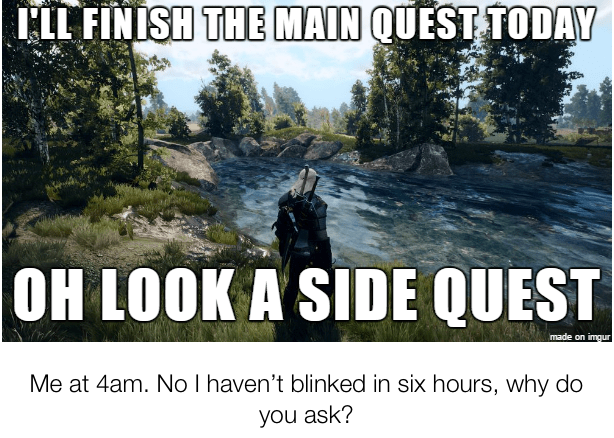
 Slowly but surely I began to gain confidence in my skills, so I am happy to report that I have  completed The Witcher III: The Wild Hunt. And yes, do I mean COMPLETED (both DLCs included).


The ironic thing about this little anecdote was that Greg played the game years ago and at the time, I’d not been overly enthused, for whatever reason I still cannot fathom - only that it was supposed to turn out this way. Yes. Fate, my friends. Greg continued to tell me over the years that this would be the game to win over my heart. I would invest my soul into the story and characters because it had everything, and I mean he said EVERYTHING, that I love. 


Like it’s always my turn? Greg’s always right. 


So a few weeks ago, I took it upon myself to embark on this journey, for the most part, by myself. Though Greg sat by my side and consulted, even despite my snappy retorts. 


Scene:

 Greg: Make sure you save the game before you go near that cliff, this isn’t Assassins Creed-

Emily: I KNOW! Stop telling me what to-  

*Emily falls off the cliff without saving game. Greg holds back laughter. Emily turns apocalyptic with rage* 

FIN.


I played 99% of the game. Funny enough, Greg was the one traipsing across the countryside, my chauffeur if you will, while I took five minute breaks to collect myself from a back alley brawl over elven rights followed by an unfavorable conversation with a couple of sorceresses.  


Greg watched in astonishment as I cut down foes, fearlessly charged into battle, upgraded weapons, got the best gear, wielded powerful magic, did every side quest, and took on all the monsters and bosses that turned my way (while helping every person I came across who was in need.)


I finally set the controller down. My heart was racing. I looked at Greg. He looked at me. 


“You beat the game You did so many side quests that you can play both expansion packs now. I never got a high enough XP level to do them before. You’re insane.” 


I smirked at him wickedly, “Well then, my dear Witcher, what say you? Shall we?” 


Of course, this was my plan all along. I was absolutely determined to beat the game plus the expansion packs when I saw a “notice” that I would be able to acquire a beautiful villa with acres of glorious, isolated countryside…


 On a motherfucking vineyard. 


I knew, in that moment, I would stop at nothing, no task would be too great, no maiden more desirable, than a perfect ending to my journey: me, sitting in my villa, drinking homemade wine. The elusive Witcher, the wanderer, the one who roamed for hundreds of years, searching for purpose and peace, would finally settle down; would finally have a home. 


Yes, best be assured, I acquired said vineyard and villa and land. Most importantly, Greg was able to the experience the continuing story he’d not been able to previously do. I’d like to think we inspire new thought in one another, and as artists and partners, this is so important. 


Bottom line: It was awesome. We had so much fun. We laughed, we yelled, I cried, I panicked, I raged, I…you get the point. 


I think Greg was a liiiiitttleeee impressed. 


So what does this have to do with art, Emily? I thought this was an “art” blog? Okay, well it is. Video games are 100 percent, absolutely, a form of art, of storytelling that I am so thrilled to have discovered (and if you don’t believe me, check out Ghost of Tsushima). 


Can’t you tell by how passionately I speak about them? Do you really think I would take the time to write this post if I didn’t believe in what I was saying? 


Video games have the same affect on me that a really good show or film does, even more so actually. I completely give myself over to the character I take on, not unlike performing. Gaming mirrors art perfectly, even life—the hardships, the journey, the discovery of self and ultimately the triumph of completing a performance, a goal. The emptiness I feel when I close a production is the same heartache that fills me when I finish a really good game. You artists know what I’m referring to…dun dun dun: the void!


Though I sometimes play on my own, I love it most when Greg and I play together. Not together as in a multiplayer game, though sometimes we do break out the old Mortal Kombat or Crash Teaming Racing, but together as in we will embark on a journey, as a team, splitting the game down the middle- he will battle and I will quest, he will quest, so I go to battle. Or he takes on anything that gives me anxiety and frustration—usually stealth missions infuriate me the most, I’m awful at being quiet. But I pick up the slack when he’s like “How did you see that?”  Or “What direction am I going in?” Simple as that. 


We switch off playing depending on what is happening in the story. Given most of the games we play require us to make choices, I realized I was actually learning things about him based on what route he would take in the game and vice versa. It became an obsessive activity, to fall into a world that we would be able to immerse ourselves in while also applying our own morals and values to our journey. I wonder if there are other couples out there who enjoy this. Its one of the most wonderful bonding experiences I’ve shared with another human in my life. I highly recommend it.  


Image from iOS (51).png

I think what I like most about our strange little tradition is that it has brought us even closer together and allowed us to develop an understanding about how we would react in situations based on how the story is played out. I will scream at him if he makes a decision I most assuredly will regret and he will bellow at me to go left when I’m dead set on going right. But that is the beauty of it, forcing us to work together to complete the tasks. Even if we don’t always see eye to eye, we have the same end goal—to beat life. I uh, mean the game. Yeah, to beat the game!  


Gaming has not only been an excellent way to pass the nights of quarantine, but it has also been inspiration for my own writing. I am blown away by the story-arcs, absolutely thrilled with the characters that I love just as hard as I hate, and the visual appeal of discovering new worlds, both familiar and foreign, has given me countless ideas for my own work. 


If you haven’t given gaming a try, I highly suggest you do. Not only will you learn something about your partner, you might even discover something about yourself. For those who say video games are for kids, I say you’ve not found the right game for you. Keep searching. 


Fun Fact: I voraciously look forward to Greg’s birthday each year. It’s when he usually receives a slew of new games, an absolute treasure trove. 


He looks at me with a devilish glint in his eye, “You know these are my games, right?” 


I nod demurely and let him think he’s won, little does he know he will be handing that controller over in no time. 


It’s a shared experience that has brought us closer together.  It’s a form of art that transcends not only observation and study, but actually allows you to become the game. It's your own personal story, a journey into yourself—there’s much to understand from that idea alone. 


I am utterly grateful for this learning experience filled with artistic enlightenment and will continue to quest to my own heart’s content. 


Thanks, Greg. You’ve opened my world and inspired me once again. 


With love & late nights,

Stevie GB – The World’s Funniest Accountant Celebrates 30 years on Stage

The year was 1982. My new wife and I attended East Side Comedy Club in Huntington, NY. It was considered the premiere comedy club on Long Island. I don’t remember who the headliner was because I was focused on the feature act, sometimes known in comedy as the middle. It was a guy named Bobby Collins. As I watched in hysterics, I recall turning to my wife and saying “I want to do that someday”. Little did I know that 30 years later, I would be the opening comedian for Bobby multiple times. I think every performer has that one person that inspires them to make the big move. 

It took me 9 years after that 1982 show to actually take the plunge. However, it was not by choice, but rather a dare. I was out to lunch with my office co-workers at my accounting job at a place called The Juke Box Café in Hauppauge. A themed restaurant owned by WBAB DJ Bob Buchman. Meredith, from the office, pointed me to a poster on the wall and said, “Look at that!” It read: Talent Night. Singers, Comedians, Magicians, bring your talent every Wednesday. Win valuable prizes

“You should sign up,” Meredith continued.  

“Me? I can’t sing.” 

“No! Comedian! You’re hilarious. You can do jokes about where we work” 

(By the way, that never works). I didn’t say anything, but just stared at that poster. 

I was always funny; I got it from my dad. I watched comedy for years. I think it started when, at around the age of nine, my mother sat me down in front of the TV. “Watch this - it’s funny.” It was Duck Soup featuring The Marx Brothers. I had no idea what I was watching, but I was immediately drawn to Harpo since he was the slapstick a kid of nine would understand. It took many years before I understood the genius of Groucho Marx, one of my comedy heroes, who I had the honor to portray many times over the last 10 years.

At 10, I discovered making the bullies laugh stopped them from picking on me and making the girls laugh was fun, though it never really got me anywhere. I am pretty sure it was the acne that kept them away. Throughout school I would listen to all the classic comedy albums like George Carlin Class Clown, Robert Klein, Bill Cosby, etc. and repeat them verbatim in school the next day. I wasn’t just a fan of comedy; I was a student. 

By the time 1991 hit and Meredith showed me that poster, I was already a well-trained comedian, without setting foot on stage.  So, I signed up for the talent show.  They gave me 15-minute spot in between all musical acts. I was the sole comedian on the show. I didn’t know until years later that doing 15 minutes for the first time, in-between musical acts, equated to comedy suicide. As they say, you don’t know what you don’t know. I only had 6 days to prepare my 15-minute set. I wrote down every joke I ever heard from my dad and many observations I had thought about over the many years. I practiced over and over and I felt ready. I decided to use the moniker of “The World’s Funniest Accountant” since accountants are never thought of as funny. I threw on a bowtie and some suspenders and used an old nickname I had from the late 70’s. I was a punk rock fan and spent many nights at CBGB, the famous NYC club. I was there so often, one of my friends started calling me Stevie GB. I thought it had a nice ring to it. Hopefully easy to remember. Turns out, I was right. 

The night came and I was sweating bullets. My entire office staff came to watch me. Not sure if they were rooting for me or hoping to watch me crash and burn. I was not scared; I was in a state of euphoria. Now, this is the part of the story where I’m supposed to say I bombed horrifically. I didn’t. I don’t really remember much of it. It was an out of body experience. I ended up taking 3rd place in the contest and my valuable prizes were a t-shirt and a Bonnie Raitt cassette. More importantly, on my ride home, I discovered what I was meant to be. A comedian. I thought to myself, this was it. I should be famous in a couple of months. I’ll be on Letterman by Christmas and be able to quit that stupid job. It didn’t work out that way. Oh, glorious delusion. 

Over the last thirty years, I have been lied to, ignored, robbed, cheated, and insulted. I quit 3 times only to return because not doing it drove me crazy. 

I have never had a sitcom. I never made it to Letterman or any late-night show for that matter. But I have had many small successes along the way. I have written and produced three One-Man-Shows. I portrayed Groucho Marx in a play with The Marx Brothers to rave reviews, including a cover story in Newsday, selling out 23 consecutive shows around Long Island. I have written 12 One Act Plays, a full-length play and a musical, many which have been staged in various NYC theaters and festivals. I have opened for my comedy hero Bobby Collins eight times, and performed at Westbury Music Fair opening for Dion & The Belmonts in the full round sold out show of 3,000 people. I have performed at the 1,500 seat Paramount Theater in Huntington 10 times, opening for comedy greats such as Norm Macdonald, Dennis Miller, Rob Schneider, Louie Anderson, Bob Nelson and more.

I have also performed at firehouses, libraries, churches, backyard parties, block parties, private homes (including living rooms), and of course comedy clubs. I spent 2 years travelling on the road to Pennsylvania, New Jersey, and Ohio and I hated every minute of it. The road is not for me. I love Long Island and have very little trouble getting booked locally. It’s been an amazing journey filled with highs and lows and I’m not finished. 

During my time as a comedian, I have also performed as a stage actor in many community theatre productions. Mostly Neil Simon plays, portraying Felix Unger in The Odd Couple, Mel Edison in Prisoner of 2ndAve, and many more. 

I help out new comedians with joke structure, stage presence, and try to tell them about the pitfalls of the business, even though I am still trying to figure that part out myself. 

As I approach my 30th year, I have no idea where the time went. When I get down on myself because I haven’t “made it”, I look back at what I have accomplished and I can stand tall and say, I am a comedian. It’s not about fame and fortune. It’s about constructing solid jokes and stories and bringing that creativity to the people. The energy of the stage and the sound of the laughter from something I created is like a warm hug. 


Picture2.jpg

Stevie GB

Award-winning comedian, actor and playwright.

Stevie GB is an award-winning comedian, actor, and playwright. Known as the world's funniest accountant, Stevie has performed at Westbury Music Fair opening for Dion, and at the Paramount in Huntington opening for comedy giants like Dennis Miller, Louie Anderson, Rob Schneider, Norm Macdonald and many more. He has written and performed three one-man shows, 12 One-Act plays and a full length musical that appeared Off-Broadway. He has also performed as Groucho Marx to critical acclaim in Newsday. Featured on Amazon Prime and on News 12.

G&E In Motion does not necessarily agree with the opinions of our guest bloggers. That would be boring and counterproductive. We have simply found the author’s thoughts to be interesting, intelligent, unique, insightful, and/or important. We may not agree on the words but we surely agree on their right to express them and proudly present this platform as a means to do so. 


How to Successfully Design Costumes for Theatre and Dance

Picture21.png

Costuming for theater is more than it seems. When costuming a production there is much to be considered.

Most audience members visually see the performers on stage and do not recognize to what extent costumes play a vital role in the execution of a story. A costume designer goes through several rigorous tasks to complete the process of creating a costume specific to a character based on a story.

On stage, a character appears and what they wear influences how they interact with other actors, set pieces, choreography and many other elements they encounter. Costume design is a fundamental part of each production as it is in any other department related to mounting a production. It is a collaborative work between the lighting designer choreographer, director, and the costume designer.

To achieve a successful costume design, a designer must understand all of the requirements of the character by reading the play and highlighting each necessary element to make the character come alive. 

Research is a very important feature in executing accuracy of each design. The costumer must understand shape, color, style, and form for each era of clothing. 

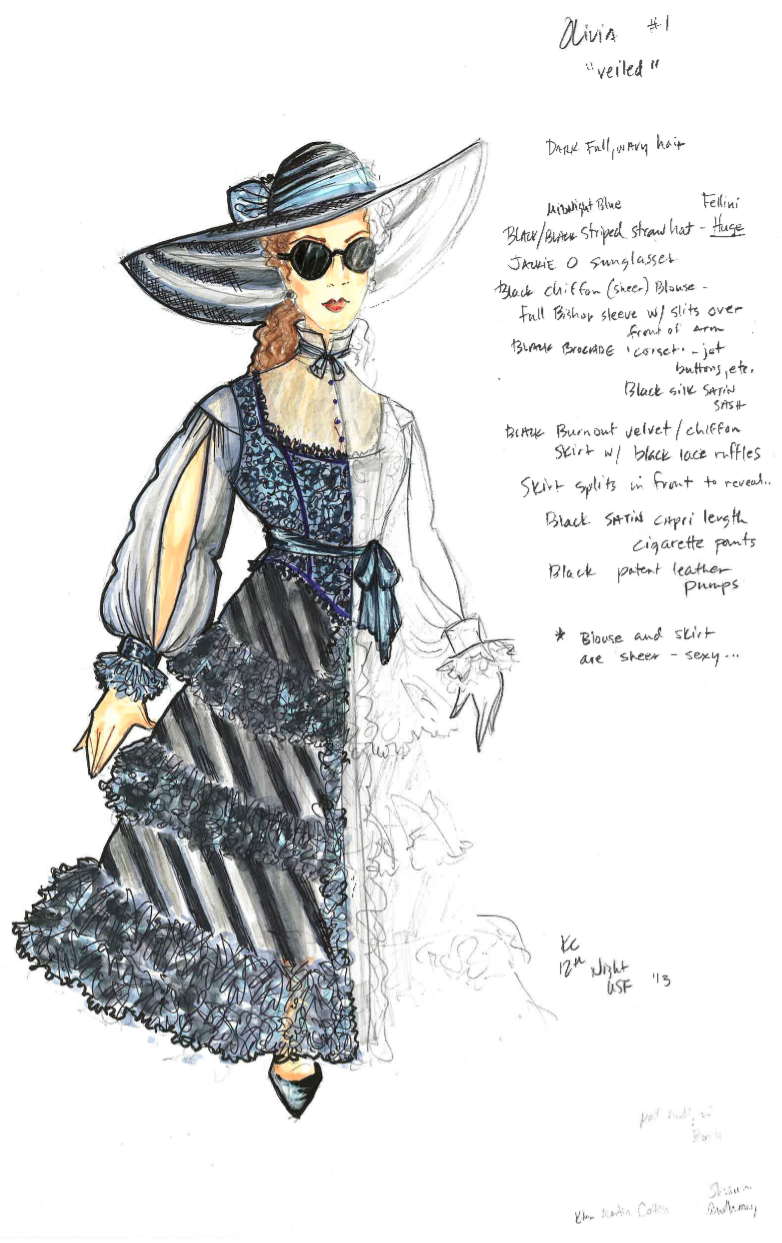
Rendering is the second phase after the design process. After sufficient research has been conducted, the costume designer sketches and paints what each costume would look like on the actor’s body and how it would move on the character. After rendering costumes sufficient for the production and being approved by the director, the costumer could now start acquiring pieces of costume either by making, fabricating, renting, or borrowing.

Picture1.png

Clear renderings provided to shop managers and fabricators makes the design process a bit easier. Patterns on costumes may not always be exactly what is sketched by the costumer, but it must be approved if a variant is acquired elsewhere. Costumes may be acquired from other theater companies that have used similar pieces, or that have been made, drafted from flat patterns. 

Before starting the process of acquiring costumes, measurements must be taken for each actor. These must be taken accurately for a proper fitting. Several measurements, which are standard to the clothing industry, can be used to design a costume, or the costume designer can formulate their own set of measurements.  

With all the necessary measurements, the design crew can now acquire all the costume pieces required for the production. After the chief costume designer has approved each piece, fittings can be scheduled for the actors and actresses. If the costume designer has selected a piece that is appropriate for the character but does not fit the actor, then alterations can be made to adjust the piece so that the costume fits the actor appropriately. 

Once all the pieces are acquired by the shop crew and approved by the costume designer, a costume parade is scheduled to present the selected costumes to the director for their authorization. In this meeting, it is essential to have the lighting designer present so they can also have an idea how the light will cast upon the characters’ costumes.

Once the director, the lighting designer, and the costume designer have approved all pieces, costumes can now be placed for the performers access during the technical week ahead of opening. If there is a particular case where the actor needs a piece for rehearsal, a mock piece or rehearsal piece is provided. 

These basic steps can assist with executing a proper costume design for a production. There are a lot of different elements to take into consideration when designing costumes. How they move on the performer, how they appear onstage under lights and how they fit performers are all elements to a successful design. Research, rendering, measuring, acquiring, and fittings must be done for every production. If all these steps are followed and fit within the budget of the production, you will have a successful costume design.


69237405_10219946797766505_2382465977393610752_n.jpg

Avelon Ragoonanan

Artistic designer with over 20 years in the performing arts from Trinidad and Tobago

Avelon Ragoonanan is an artistic designer with over 20 years experience in the performing arts. He is from Trinidad and Tobago. Avelon has designed productions in the Caribbean and the United States. He has worked with Pacific Lutheran University, Act 1 Theatre Productions, Cirque Du Soleil and many other theatres on several design elements including scenic design, costume design and construction. Avelon has designed for shows Off Broadway and on US tours for productions such as Dance Ensemble (2011-2015), Macbeth, A Midsummer’s Night Dream, Almost Maine, Our Town, Empowered, Mrs. Packard, Dead Man’s Cell Phone, Steel Magnolias, Inspecting Carol, Kiss Me Kate, Mother Courage, Three Sisters, and Into the Woods. He holds a Bachelor of Fine Arts in Dance and a Bachelor of Fine Arts in Theatre and has won several awards for designing, acting, dancing, choreography and directing. Avelon has also had the honor to perform for the President of the Unites States in the Summit of the Americas in 2009. 

G&E In Motion does not necessarily agree with the opinions of our guest bloggers. That would be boring and counterproductive. We have simply found the author’s thoughts to be interesting, intelligent, unique, insightful, and/or important. We may not agree on the words but we surely agree on their right to express them and proudly present this platform as a means to do so.